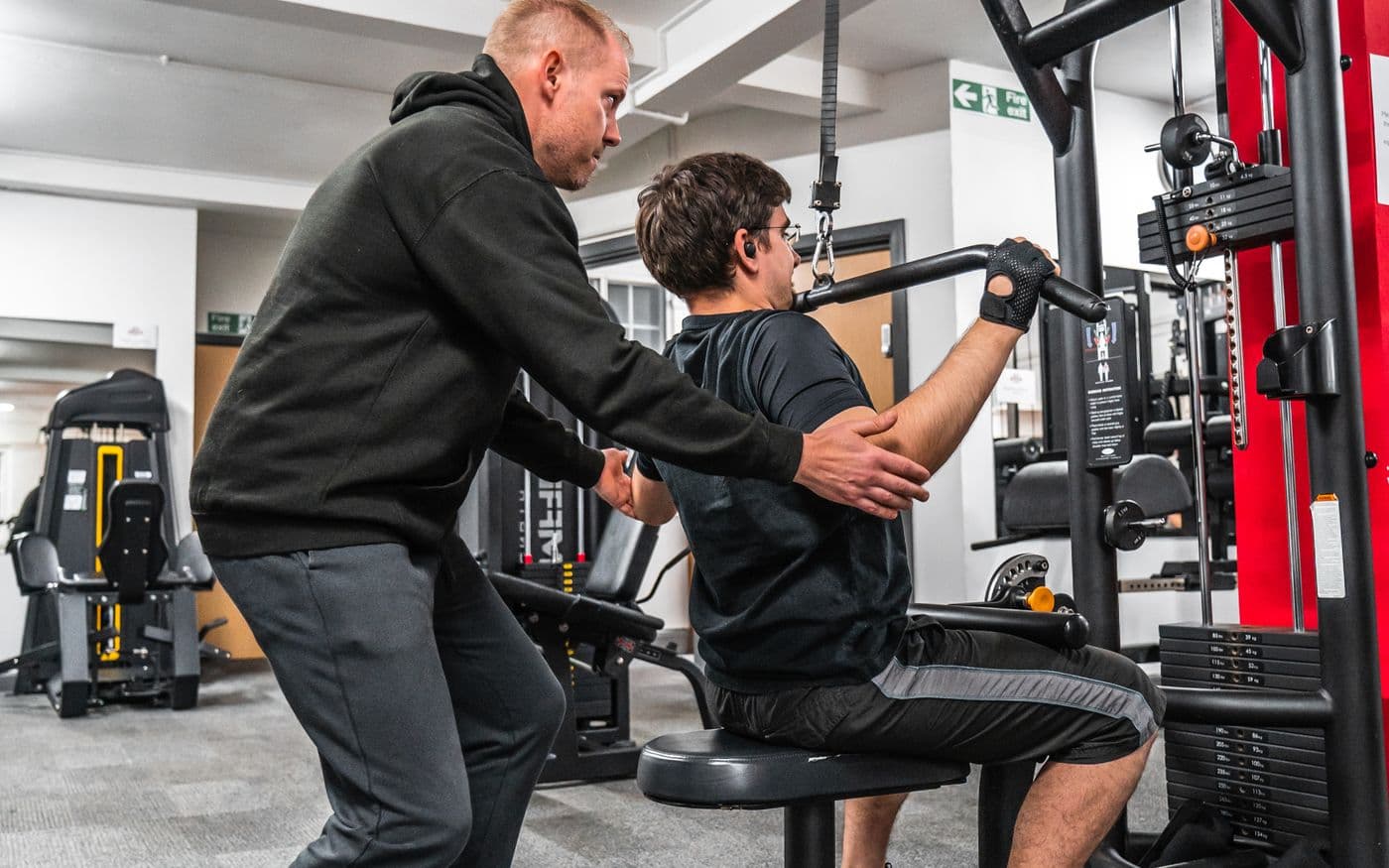
In the trial session, the prospective member comes into contact with the coaches and the facilities for the first time. What happens in that hour decides whether a guest becomes a member – and whether that member is still there in three months. The remarkable thing about it: although the trial session is tailored to the physical condition and the wishes of the potential new client, it follows a standardised course. It is precisely this combination of a fixed procedure and individual adaptation that is the craft at issue here.
A distinction: the trial session is not a sales conversation
The two appointments are often mixed up in everyday practice, and each has its own logic. The sales or initial consultation is about expectations, offer and decision – how to lead one is described in the article The perfect initial consultation as a personal trainer. Here it is about the training session itself: about goal definition, health evaluation, training planning, delivery and analysis.
According to training theory, the aim of the trial session is clearly formulated: to convince the guest of a membership through a perfect service. So it is not an aimless taster. But the lever for that is the quality of the training session, not persuasiveness in conversation. Two documents serve as the basis for the documentation: the health questionnaire and the training programme.
Steps 1 to 3: goal, health, plan
Training theory summarises the organisational procedure of the first trial session in five steps: goal-setting conversation, health evaluation, training planning, delivery of the session, and analysis and evaluation. The first three decide what is actually trained.
1. Conversation to define the goal
The training planning process starts with the definition of the goal. What matters is finding out what the guest's main goal is – and every training guest should state only one main goal. Where there are several goals, these are recorded as further training goals. It should be borne in mind that the goals are set realistically.
Goal setting also includes the training duration: how many sessions does the guest want to complete per week, and how much time should be allowed per session? A detail that tends to get lost in practice – what is recorded is the pure training time, that is, without changing and showering. Anyone who does not separate this cleanly will regularly plan sessions that do not happen in real life.
The third point is motivation. It is an important factor in the regularity of training, and regular attendance is decisive for training success. Motivation should therefore be actively asked about – and if needed a refresher session is arranged directly for four to six weeks later. That appointment is, incidentally, one of the most effective retention instruments there is: it is arranged during the trial session, not chased up by telephone afterwards.
2. Health evaluation
In the health evaluation, all health complaints and clinical conditions are recorded. As much information as possible about the guest's state of health should be gathered – for two reasons: on the one hand to be able to estimate the training load, and on the other to build in training exercises that improve the guest's health.
The second reason is often overlooked. The health questionnaire is not a liability form to be filed away but a source for exercise selection. Clarity of role matters here: as a trainer you record and take account of complaints, you do not make a diagnosis and you do not treat. Anything that needs to be investigated belongs in medical or physiotherapeutic hands – and that is where you refer the guest before you train.
3. Training planning
In the training session, the training components should be applied in accordance with the individual goal and the health evaluation: strength, endurance, coordination, flexibility and relaxation. The plan therefore emerges from the first two steps and not from a standard template. For many guests, strength training is at the centre; depending on the goal, the further components are added, although only two or three components may well be covered if that corresponds to the goals.
Step 4: building the training session
The session itself follows the structure of every training session: preparatory part, main part, closing part. In the main part, the goal-oriented and individually adapted training is carried out; the working methods differ greatly depending on the goal and have to be evaluated carefully.
The preparatory part involves more than the classic warm-up. It also includes attaining the psychological readiness to perform – achieved by deliberately directing concentration towards the training. For successful training, an optimal readiness to train and a minimum of intrinsic motivation are indispensable. For physical readiness the following applies: depending on the performance component, this part is of greater or lesser importance. While the warm-up plays a smaller role for fitness training with controlled movements in the fitness centre, it is of great importance before speed training. For all types of training, the rule is to choose coordinatively simple and familiar exercises.
One point that is often got wrong in the trial session: a warm-up in the sense of an unspecific rise in muscle temperature brings no additional benefit before strength training. The risk of muscular injury comes less from the temperature status than from the explosiveness of the movement, because jerky movements can produce load peaks above the breaking load of the tissues involved. For beginners a warm-up is generally to be recommended, and with a time under tension of 30 to 60 seconds it may be advisable to practise the movement beforehand with a light weight. The same applies after a longer stay in cold outdoor temperatures. There is nothing against it, however, as long as it is neither too intense nor too long; the individual wishes of the trainee should be accommodated. Why a modern warm-up is more than muscle temperature is explored in the article Warm-up 2.0.
If several components are trained, the optimal sequence of loading applies: first coordinatively demanding content, then strength or muscle training, and endurance training last. Coordinative content requires a rested state of the body and therefore always comes at the beginning.
The closing part initiates recovery. Three requirements should be met: through a stepwise reduction of the load, loosening exercises and relaxation techniques, the load on the nervous system and the musculoskeletal system should be released; the metabolic and cardiovascular systems should return to their resting state; and the training should always have a positive and enjoyable ending, so that the next session can begin with positive thoughts. The last point is the most important one for retention – and the one that most frequently falls victim to the clock.
Step 5: analysis and evaluation
During the follow-up, the coach should reflect on the session. Training theory sets out six questions for this:
- Were all the exercises explained in detail?
- Are all the machine settings noted on the training programme?
- Is the training programme matched to the training goal?
- Does the guest gain a clear health benefit?
- Was the guest informed about the next steps?
- Does the guest know that the coach is available at any time for further sessions or questions?
This list is at the same time the best error check there is for the trial session. Four of the six points concern not the quality of the training but its traceability: noted machine settings, explained exercises, known next steps, a reachable coach. Anyone who does not deliver that sends a guest into a session they cannot repeat on their own.
The second trial session
If a guest feels unsure or a session could not be discussed in full, there is the option of a second trial session. It follows the same structure as the first and differs in a few but clear points.
Filling in the health questionnaire is dropped; instead, its content has to be studied closely and queried with the guest if needed. The training programme also has to be studied beforehand. Unless the guest explicitly wishes otherwise, the training programme is implemented 1:1 as the trainer of the first trial session drew it up. If the guest's body reacted too strongly to the training, appropriate adjustments can be made – and these have to be noted on the health questionnaire. The machines no longer have to be demonstrated during the instruction.
The point about the 1:1 implementation looks inconspicuous and is not. A colleague who quietly rebuilds a predecessor's programme gives the guest the impression that the first appointment was worthless. In delivery, the second trial session is about monitoring and correction – but explicitly also about praise for good exercise execution.
Mistakes that cost retention
The typical stumbling blocks can be derived directly from the procedure. Letting several main goals stand: anyone who does not condense down to one main goal writes a programme that does a bit of everything and nothing properly. Planning training time including changing: the guest then experiences the session as too long and breaks it off. Just ticking off the health questionnaire: that throws away the exercises that benefit the guest's health. Not noting the machine settings: at their first independent session the guest stands helplessly in front of the machine. Cutting the closing part: the session should have a positive ending so that the next one begins with positive thoughts. No refresher appointment: without the agreed follow-up appointment after four to six weeks, the anchor in the diary is missing.
And finally: planning also means continually adjusting what has already been planned. That includes reflecting on and analysing your own delivery of training on a regular basis. More on the psychological side of support after the first few weeks can be found in the article The psychology of personal training.
Course tip from update Akademie: Leading a trial session properly calls for conversation skills, health evaluation and training planning all within a single hour. The Personaltrainer course goes deeper into exactly this combination for one-to-one support. If you want to go deeper into the structure of the training session itself, the workshop Die optimale Gestaltung von Trainingseinheiten is the fitting addition.
Frequently asked questions about the trial session
What is the difference between a trial session and an initial consultation?
The initial consultation is the advisory and sales conversation in which expectations, offer and decision are clarified. The trial session is the training session itself and consists of goal definition, health evaluation, training planning, delivery and analysis. Both appointments pursue the same overarching aim but work with different means.
How many training goals should a guest name?
Every training guest should state only one main goal. If they name several, the remaining ones are recorded as further training goals and are not treated as equally ranked. It is also important that the goals are set realistically so that they remain achievable within the agreed period.
Is a warm-up before strength training absolutely necessary?
A warm-up in the sense of an unspecific rise in muscle temperature brings no additional benefit before strength training, because the necessary warmth in the trained muscle is already produced during the first repetitions. But there is nothing against it, as long as it is not too intense or too long, and individual wishes should be accommodated. For beginners a warm-up is generally to be recommended.
When does a second trial session take place?
When a guest feels unsure or a session could not be discussed in full. It follows the same structure as the first, but does without filling in the health questionnaire and without demonstrating the machines. The existing training programme is implemented one to one, unless the guest wishes otherwise.
When should the first refresher session be arranged?
Already during the trial session. Because motivation is an important factor in regularity, it should be asked about and, if needed, a refresher session arranged directly for four to six weeks later. Thereafter, a refresher session after two to three months is usual in the fitness sector, at which goals and health evaluation are collected anew.
Conclusion
The trial session is the most heavily standardised and at the same time the most individual hour in the fitness centre. Its procedure is not a sales choreography but the complete planning cycle in fast motion: one main goal, a sound health evaluation, a plan derived from it, a carefully constructed session and an honest follow-up. The six reflection questions from training theory are the most honest yardstick there is for your own work – four of them check not how well you trained but whether the guest can get on without you. And the appointment for the refresher session belongs in that same hour.