
Effective muscle building
By restricting blood flow, your muscles can work more intensely, which leads to faster muscle growth.
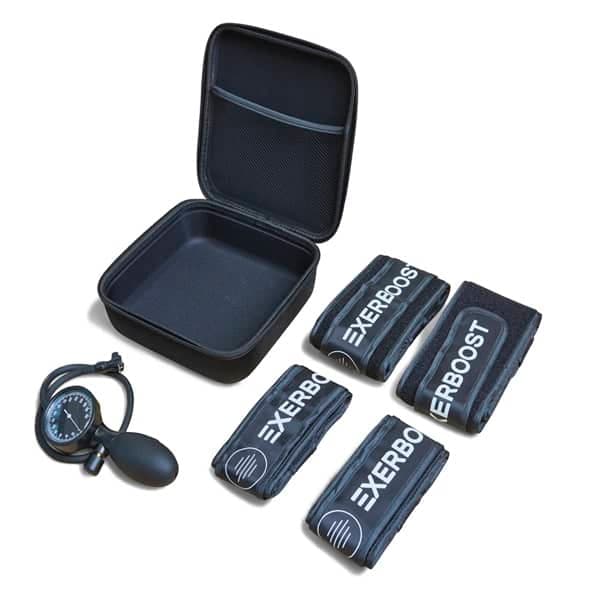
Blood Flow Restriction (BFR) bands are specially developed training bands that partially restrict blood flow in the muscles. This technique allows you to train with a lower load while still achieving maximum muscle strength and endurance.
TWINT · Mastercard · VISA · PayPal
By restricting blood flow, your muscles can work more intensely, which leads to faster muscle growth.
BFR training promotes blood circulation and the transport of nutrients to your muscles, which shortens recovery time.
Train with lighter weights and reduce the strain on your joints and tendons.
Ideal for strength training, rehab exercises and endurance training.
Start your effective BFR training today and experience the benefits for yourself. Order your Blood Flow Restriction Bands now and take your training to the next level!
In occlusion training, a cuff is used to restrict the return of blood flow from the muscle back to the heart. Due to the reduced return flow, metabolic products build up in the muscle. The accumulation of various metabolites leads to an increased release of anabolic growth factors, which means strength gains can be achieved even when training at low intensities.
In endurance training with occlusion, the arterial supply to the exercising limb is reduced, which lowers the oxygen supply to the muscles and increases the production of metabolic products. As a result, even at low intensities, maximum oxygen uptake and endurance performance in general can be improved.
If pain occurs during training with occlusion, or in case of discomfort, stop training immediately, release the occlusion and turn to your coach.
The pressure needed for maximum closure of the veins depends on the cuff width and the circumference of the limbs. In general, higher pressures are required with narrower cuffs and larger circumferences. The pressure used in occlusion training is 50–70 % of the pressure needed for complete elimination of the pulse.
The available research findings indicate that properly performed occlusion training carries no greater safety risk than for patients using traditional therapeutic techniques. It is assumed that, if the safety guidelines are followed, serious adverse effects are limited to mild discomfort and temporary muscle soreness. However, the use of occlusion training is not entirely risk-free and should therefore be carried out with caution and in observance of the safety measures.

More training does not mean more progress. The warning signs – and how to catch them in time.
→
Tired and underperforming? Who is genuinely at risk – and why iron should never be taken on a hunch.
→
Few nutrients are argued over this much. What carbohydrates really do – and who benefits from fewer.
→We advise you free of charge and with no obligation – in a one-to-one conversation or at the online info evening.