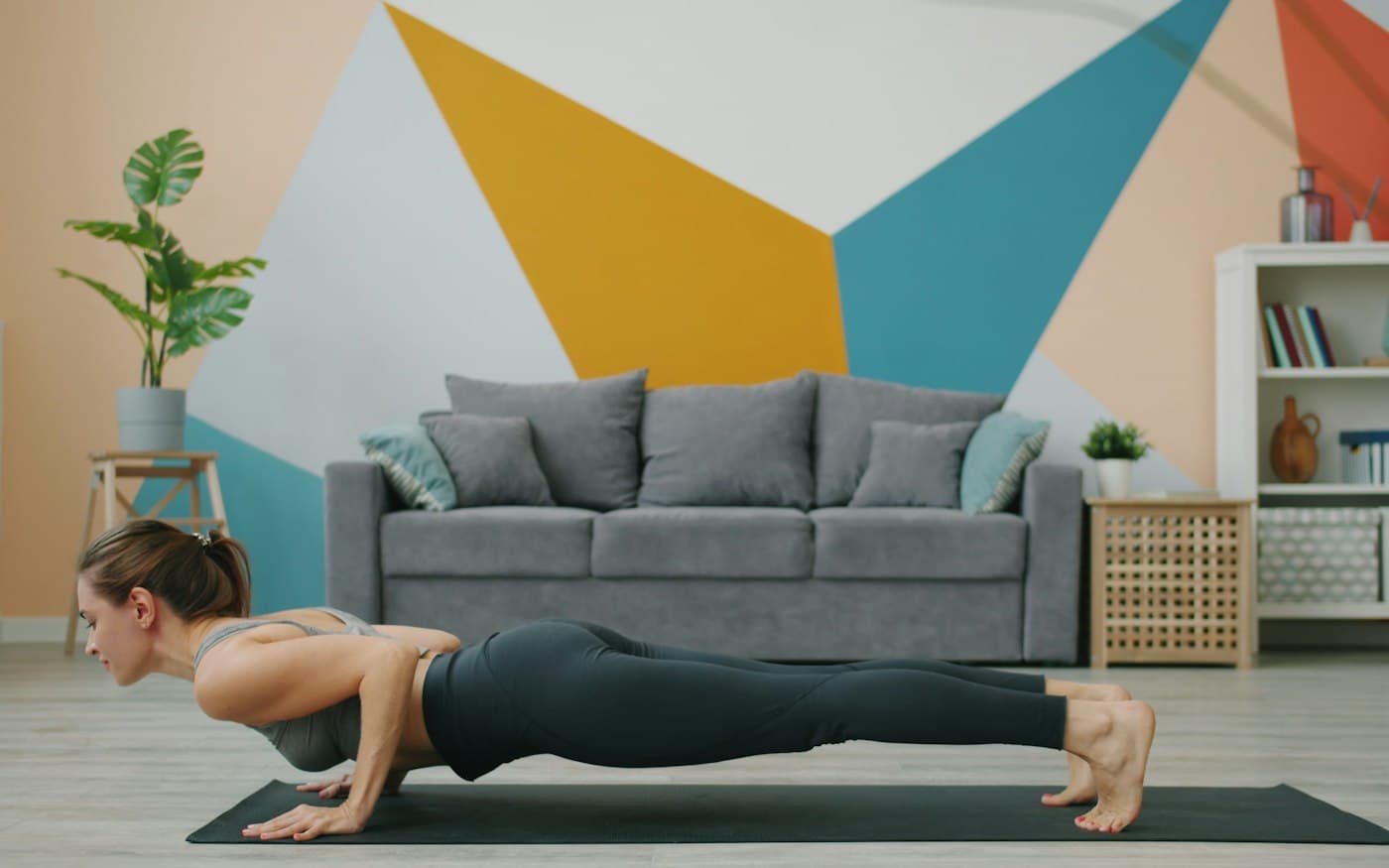
You are lying on the mat, and cues such as "activate your Powerhouse", "neutral pelvis" or "scoop as you exhale" come from the front of the room. Especially at the beginning, it is not clear what they mean and why a seemingly simple exercise suddenly becomes so demanding. The answer lies in the Pilates principles. They explain why every movement starts in the centre of the body and why quality counts for more than the number of repetitions. Here you will find out what lies behind the six principles and the Powerhouse, how to align yourself on the mat, how a class is structured and how to recognise good instruction.
Joseph Pilates and the origins of the method
The method goes back to Joseph Pilates (1883 to 1967). As a German, he was interned in Great Britain at the beginning of the First World War. During this time, he developed the concept of a holistic form of body training intended to contribute to a good constitution and posture, initially for interned soldiers. From about 1920 to 1925 he lived in Hamburg, where his first training equipment was probably also created. According to legend, the Reformer was built from an old hospital bed. You can read about what the equipment achieves today in the article Pilates Reformer: what the training really achieves.
In 1926, Pilates emigrated to New York, where he opened a training studio with his future wife Clara. In the early 1960s, many New York dancers were among his clients, and the method, originally developed for men, was increasingly perceived as female. After his death, his students opened their own studios and developed the method further.
The six Pilates principles
Pilates is a form of core training in which strengthening, mobilisation and concentration work together. The comparison Pilates vs. yoga shows how it differs from yoga. Six principles determine how an exercise is performed.
Concentration
Your attention is on clean execution while you observe all the other principles. Quality comes before quantity: a movement is only repeated for as long as it can be performed correctly. With an alert mind, you also learn movement patterns more easily.
Centring
Centring means stabilising the centre of the body, known in Pilates as the Powerhouse, and every exercise begins with it. Instead of Powerhouse, the literature also uses the term "box": an imaginary rectangle formed by the lines from shoulder to shoulder and from hip bone to hip bone.
Control
Motor control is the ability to plan a movement. You practise it through correct alignment and a gradual approach: first with a smaller range of motion, which becomes larger as your skills grow. In the Double Leg Stretch, for example, the legs only lower towards the floor as far as you can maintain the neutral position.
Breathing
The breath determines the pace of movement, individually for each person. Breath and movement should not hinder each other, for example through holding your breath or gasping. You breathe in through the nose and out through the slightly open mouth, making an audible "sh" sound. As you breathe in, the ribs open sideways like a fan (lateral breathing). As you breathe out, the scoop follows: the transverse abdominal muscle, the pelvic floor and the multifidi, which are deep back muscles, work together, stabilise the pelvis and spine and initiate the movement.
Precision
Before every movement, the posture is optimally aligned. The midline provides orientation: it runs from the centre of the pubic bone through the navel and the centre of the ribs towards the head. First the spine is lengthened, then the length continues into the arms and legs. Every movement has an anchor in the Powerhouse and a force that pulls away from it as a counterpull.
Flow
Cleanly executed individual movements flow into a sequence of coordinated movements. This flowing sequence benefits breathing, harmony and concentration, and in a well-led class you will find your own rhythm.
The Powerhouse: strength from the centre of the body
Joseph Pilates called the muscles of the abdomen, back, buttocks and hips the Powerhouse, in other words the muscles of the body's centre between the ribs and the hips. They are activated before the arms, legs or spine visibly move, and from here strength flows outwards into the limbs.
The easiest way to feel the Powerhouse is lying on your back with your knees bent and your feet on the floor: as you breathe out, engage your pelvic floor and abdominal muscles, gently draw your lower ribs towards each other and towards your hips, and lower your navel slightly towards your spine until it feels as if a corset is tightening around your waist. Pilates taps are a good way to start: lying on your back with your legs raised and bent at right angles, you alternately tap one heel to the floor.
The muscles of the Powerhouse
- Transverse abdominal muscle (transversus abdominis): with its ring-shaped fibres, it reduces the diameter of the abdomen and makes it possible to draw the abdomen in.
- Straight abdominal muscle (rectus abdominis): brings the breastbone and pubic bone closer together and flexes the trunk.
- Oblique abdominal muscles: curl the trunk forwards and rotate it; the internal oblique also bends it to the side.
- Quadratus lumborum: This muscle between the lowest rib, the lumbar vertebrae and the iliac crest bends the trunk to the side and assists with breathing out.
- Diaphragm: a large, flat muscle that separates the chest cavity from the abdominal cavity like a dome.
- Back extensors and multifidi: hold and support, straighten the trunk and rotate it.
- Anterior serratus muscle (serratus anterior): presses the shoulder blade against the rib cage and stabilises it, for example in a press-up.
- Pelvic floor: This includes the levator ani and the coccygeus, which, among other things, support the weight of the internal organs. The article on pelvic floor training shows how to train it in a targeted way.
Pilates box and posture correction
The term "Pilates box" is not used consistently: in addition to the rectangle of the body's centre, it also refers to the alignment of the rib cage, the cervical and thoracic spine and the shoulder blades. For this, the neck lengthens, the shoulder blades draw down and slightly together, the breastbone lifts, and the lungs get more room to breathe. The box and the Powerhouse work together during the exercises.
Alignment on the mat: neutral, imprint and starting positions
Before an exercise begins, you align yourself. Lying on your back, there are two basic settings:
- Neutral: the anatomically correct position of the spine. With your knees bent and your feet on the floor, the hip bones and pubic bone form a roughly horizontal plane, and there is a little space between the lumbar spine and the mat.
- Imprint: a small backward tilt of the pelvis. The pelvic floor and abdominal muscles tilt the pelvis towards the mat without the buttocks working or the lumbar spine being pressed into the mat. This safety position is intended to protect the lower back when an exercise becomes very strenuous and is best suited to beginners as soon as both legs are in the air.
The legs are often in the table-top position: the hip and knee joints form a 90-degree angle, the thighs point vertically to the ceiling and the lower legs are parallel to the floor. On all fours, the knees are hip-width apart and the hands shoulder-width apart. Lying on your front, your pubic bone presses lightly into the mat and your nose points towards the floor. For the shoulders, the rule is always: draw your shoulder blades slightly towards each other and towards your hips, and leave plenty of space between your shoulders and ears.
When standing, there is the Pilates position (Pilates stance): the legs are turned out from the hips by about 15 degrees, and the feet form a V. In Standing Pilates, it is harder to maintain the Powerhouse, and balance is constantly challenged.
How a Pilates class is structured
A Pilates class should be balanced, safe and challenging. The focus is on the Powerhouse and the core muscles, but the arms and legs are also worked. Mat Pilates can be used for all target groups, and the exercises are chosen according to level.
- Pre-Pilates: mobilisation of the large joints, the neck and the spine, an introduction to Pilates breathing and a short explanation of the Powerhouse.
- Main part: lying on your back and lying on your front feature in every class, as do exercises that strengthen the abdomen and back; overall, the whole body is trained. For beginners, sufficient breaks are included, for example in the form of mobilisation exercises.
- Cool-down: the muscles that have been worked are mobilised, for example with the shoulder bridge, followed by relaxation with breathing exercises or a body scan.
Depending on the studio, a class lasts 45 to 90 minutes, with 50 to 60 minutes considered optimal. There is usually no music setting the beat; the breath sets the rhythm. Well-known exercises include the Hundred as a classic warm-up for the abdominal muscles, the Roll Up and the "Nasty Five", which include the Scissors and the Criss Cross. Many exercises can be progressed: you only practise the Teaser once you can do the Roll Up without help from your arms.
Cueing: how to recognise good instruction
Cueing is the term for instructing with short prompts. There are three forms:
- Verbal: The voice is loud enough for everyone, but not so loud that you can no longer hear your own breathing. Good instructions are simple, use images instead of technical jargon and explain the basic alignment first, with refinements only once you are in position.
- Visual: Many people learn best by watching, so the instructor positions themselves so that everyone can see them.
- Tactile: A precise touch can give you a better sense of body awareness and alignment. Permission is asked first, corrections are made close to the centre of the body, and pressure is never applied to joints, organs or injured areas.
A good instructor also shows variations that make exercises easier or harder, does not demonstrate throughout the entire class but corrects, and asks new participants about musculoskeletal problems, injuries or pregnancy.
Course tip from update Akademie: If you want not only to practise Pilates but also to teach it yourself, the Pilates Instruktor course is the right next step. It covers the Pilates principles, the Powerhouse and its anatomy, the alignment of the starting positions, class structure, cueing and exercise sequences. The aim is for you to be able to lead your own classes afterwards.
Frequently asked questions about the Pilates principles
What are the six principles of Pilates?
The six Pilates principles are concentration, centring, control, breathing, precision and flow. Concentration means performing a movement only for as long as you can do it cleanly. Centring stabilises the centre of the body, where every exercise begins. You practise control with a smaller range of motion at first. Breathing determines the pace, precision requires exact alignment before each movement, and flow links individual movements into a harmonious sequence.
What is the Powerhouse in Pilates?
Joseph Pilates used the term Powerhouse for the muscles of the abdomen, back, buttocks and hips, in other words the muscles of the body's centre between the ribs and the hips. These include the abdominal muscles, the back extensors and multifidi, the diaphragm and the pelvic floor, among others. The Powerhouse is activated before the arms or legs visibly move, and from there strength flows outwards into the limbs.
How do you breathe correctly in Pilates?
In Pilates, you breathe in through the nose and out through the slightly open mouth, making an audible "sh" sound. As you breathe in, the ribs widen sideways (lateral breathing); as you breathe out, the transverse abdominal muscle, the pelvic floor and the deep back muscles work together, which is known as the scoop. The breath determines the pace of movement and is individual. What matters is that breath and movement go together and that you do not hold your breath.
Is Pilates suitable for beginners?
Yes, mat Pilates can be used for all target groups. Beginners first learn the breathing, the neutral position of the spine and how to activate the Powerhouse, start with a smaller range of motion and take enough breaks. When both legs are in the air while lying on your back, the imprint position with the pelvis tilted slightly backwards is the most suitable. Tell the instructor about any complaints, injuries or pregnancy before the class, and have complaints checked by a doctor.
Conclusion
You recognise good Pilates not by the number of repetitions but by how consciously a movement is created. It starts from a stable centre and follows your own breathing rhythm. The six principles provide the framework, and the Powerhouse supplies the strength. A well-structured class leads from Pre-Pilates through the main part to the cool-down and offers variations for your level. If you know these basics, you will understand the cues on the mat better and apply them more effectively.