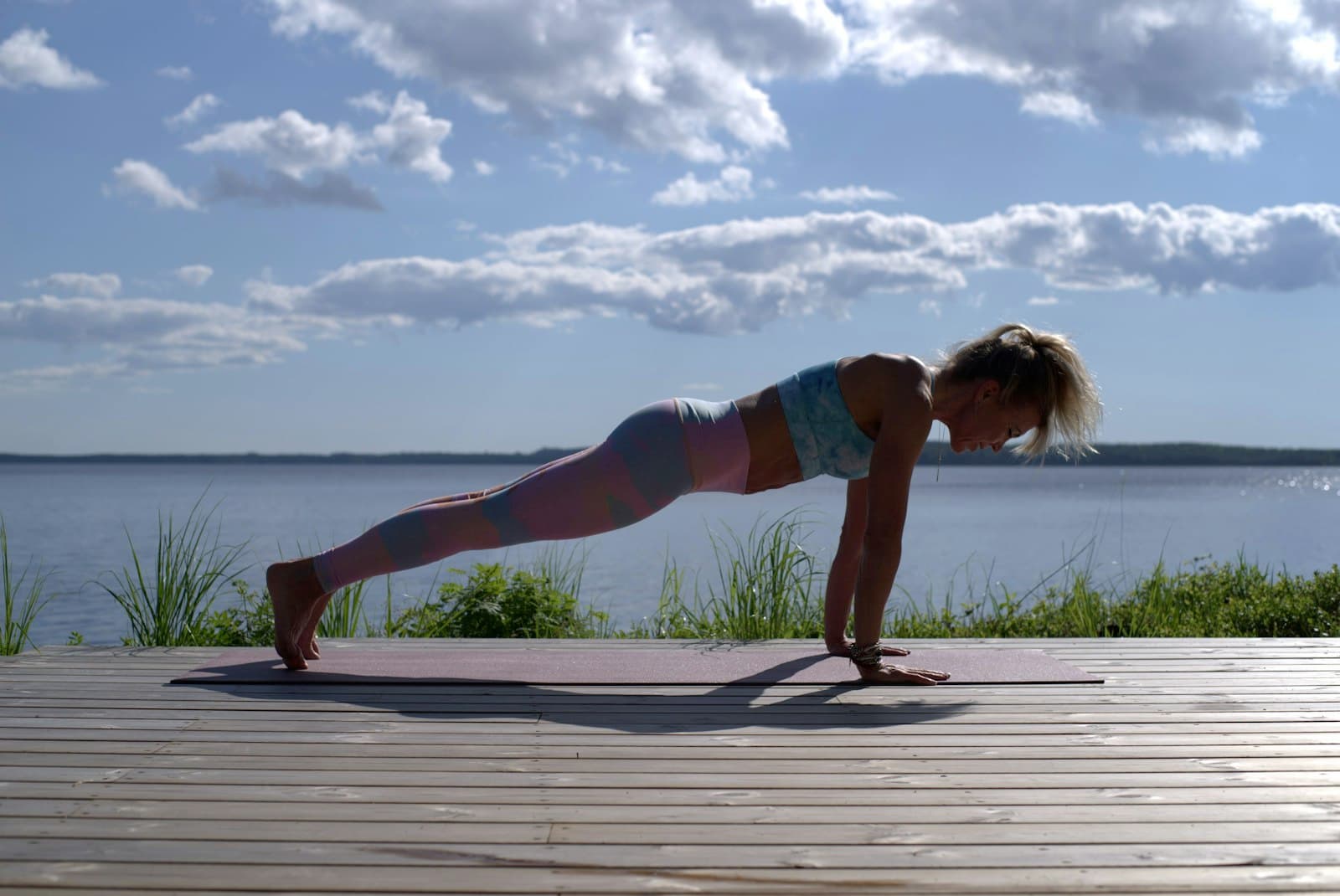
The term unilateral means "one-sided". In unilateral training, you train one side of the body after the other – so, e.g., the right and then the left leg, or the same movement sequence with just one arm.
Typical examples are: • lunges or step-ups • single-arm rowing or shoulder press • single-leg squats or deadlifts
The goal is not just to strengthen one side, but to train both separately, in order to balance out differences in strength, stability and coordination. Your body never works perfectly symmetrically – but it can learn to use both sides more efficiently and in a more balanced way.
Why one-sided training brings more than strength
When you train unilaterally, your body has to do significantly more stabilisation work. Standing on one leg or pulling with one arm automatically activates the core, hip and shoulder stabilisers – muscles that often assist in two-sided exercises, but are challenged less strongly.
This way, unilateral training improves not only strength, but also balance, movement control and joint stability. In a functional context in particular, this is crucial: most everyday and sporting movements are unilateral by nature – running, throwing, jumping or striking almost never happen symmetrically. That's why single-leg or single-arm training reflects the actual movement patterns of life and sport much more realistically.
Scientifically, too, it's clear: one-sided loads promote a higher intermuscular coordination – that is, a better cooperation between different muscle groups. This neuromuscular control is the basis for efficient, powerful and safe movement execution.
In addition, training with both legs at the same time – for example with squats or deadlifts – does lead to higher absolute loads, but also to a greater mechanical load on the spine. That means: the compressive forces on the spine can be high, even when the load distribution is symmetrical. In unilateral training, the external loads are usually lower, which reduces the axial compression on the spine – despite intense activation of the stabilising musculature.
It's also remarkable that: well-trained unilateral athletes often develop a single-leg strength performance that almost matches their bilateral value. This shows how effective and capable unilateral training can be.
The brain trains along – the crossover effects
A fascinating aspect of unilateral training is the so-called cross-education effect. It describes the fact that strength gains partly transfer to the side that isn't actively trained – mediated by neural connections in the brain.
So if you train, e.g., only the right arm, the strength in the left arm can also improve, even though you didn't load it. This is because the nervous system stores and optimises movement patterns centrally. So you're not only training muscles, but also your brain to coordinate movements more efficiently.
This effect makes unilateral training particularly valuable in rehabilitation: after injuries or operations, you can continue to make progress without overloading the affected side – your nervous system stays active and "keeps learning".

Would you also like to turn your hobby into a profession?
Discover the various training programmes of the update Akademie and qualify as a fitness trainer!
Stability begins in the middle
In all one-sided exercises, your body has to prevent you from tipping to the side or rotating. Here your core plays a central role – that is, the entire core musculature including the deep holding muscles.
These muscles generate anti-rotational stability: they hold the body axis while one side works. As a result, the core is automatically activated more strongly during unilateral training than in many two-sided exercises.
Example: single-arm rowing with a dumbbell engages not only the latissimus, but also the oblique abdominal muscles, the back extensors and the glutes, in order to keep the body stable. This creates a training effect that goes far beyond the target muscle – towards functional stability and whole-body control.
Why training shouldn't always be the same
Bilateral training (e.g. squats, bench press) remains indispensable – it allows higher loads and promotes systemic adaptations. But those who train exclusively two-sided often overlook asymmetries: the nervous system automatically compensates with the stronger side, so that weaknesses go unnoticed.
Only when working unilaterally does it become apparent how balanced your body actually is. That's why it's worth combining both approaches: • bilateral training for maximum strength and muscle volume, • unilateral training for balance, control and functional stability.
This combination creates whole-body strength that transfers to sport, everyday life and movement quality.
Practice: here's how to integrate unilateral training sensibly
You can use unilateral training in various ways: • In the warm-up: for activation and mobilisation (e.g. step-ups, single-leg stance with a pulling movement) • In the main part: as a targeted strength stimulus (e.g. Bulgarian split squats, single-arm pressing, single-leg deadlifts) • In rehab or prevention: to restore balance and control
Make sure to train both sides equally often and equally carefully – even if they feel different. Start with the weaker side to keep your focus. And: better stable , slow and controlled, than unstable with too much weight.
Conclusion: train one side – benefit as a whole
Unilateral training is not a substitute, but a valuable extension of your training. It trains your nervous system, improves posture and coordination, strengthens weaker links of the movement chain – and makes you more stable overall.
Training one-sided means consciously and equally developing both sides. Because true strength shows not only in how much you lift, but in how harmoniously and controlled your body works together.