The first few steps after getting up hurt your knee, and after a few minutes of movement it gets better. Or your groin hurts as soon as you have been on your feet for a while. If your doctor then mentions osteoarthritis, many people feel very unsure: should the joint now be rested or, on the contrary, kept moving? This article explains what happens in the joint with osteoarthritis, how it differs from arthritis, why cartilage depends on movement and what training that complements medical treatment can look like.
What osteoarthritis is: when the load exceeds the load-bearing capacity
Grifka and Krämer (2013) describe osteoarthritis as a "degenerative joint disorder caused by a mismatch between the load on the articular cartilage and its load-bearing capacity". Degenerative means that the disease develops through steady wear and tear of the tissue until functional failure eventually occurs. Unlike arthritis, it begins with prolonged mechanical overload.
The wear is often due to an unfavourable distribution of forces concentrated on vulnerable tissue. In knee osteoarthritis, for example, the cartilage is worn down by the bony parts of the joint and can only be rebuilt with great difficulty. Experts distinguish between primary osteoarthritis, which develops on its own, and secondary osteoarthritis, which occurs as a result of an injury or operation.
Osteoarthritis or arthritis: the key difference
The terms sound similar but mean different things. Arthritis means inflammation of a joint. It can be caused by infections with bacteria, viruses or parasites, by rheumatological diseases such as polyarthritis or by other, non-infectious inflammation such as gout. Typical signs are pain, which can be severe, redness, swelling and increased temperature in the affected joint. In rheumatoid arthritis, often called rheumatism in everyday language, the immune system attacks the body's own joints and causes inflammation in many places at the same time.
Osteoarthritis, by contrast, often has no inflammatory component or only a very weak one and therefore shows no typical signs of inflammation. It mainly makes itself felt through pain that depends on the position and loading of the joint. Usually a single joint is affected, and rarely the same joint on the other side as well. Polyarthrosis, in which many joints are affected at the same time, is rare. Which condition is present is determined by a doctor. This matters for training: with arthritis, the approach depends on the cause of the inflammation, and training within the limits of pain-free movement is possible in principle.
Why cartilage depends on movement
A look inside the joint shows why movement is so important in osteoarthritis. In a true joint, such as the hip or elbow, the two articulating bone ends are covered with cartilage. Between them lies the joint cavity containing the synovial fluid (synovia), enclosed by the joint capsule. The cartilage protects the bone from pressure, friction and direct abrasion.
The special feature: in adults, cartilage has no blood vessels. Its cells are supplied by diffusion, that is, through exchange with the synovial fluid, which also acts as a "joint lubricant". For the cartilage cells to receive enough nutrients, the joint has to be moved and loaded a lot. You can think of cartilage as a sponge: when the load is removed, it soaks itself full, and under load it squeezes the waste products out again.
This type of supply has a downside. The metabolism and regenerative capacity of cartilage are low, and injuries heal only poorly. Bones behave differently: they build up new substance where they are loaded and break it down when loading stimuli are absent. The article Strength training for strong bones explains more about this.
Knee, hip, shoulder: how osteoarthritis shows itself
Knee osteoarthritis (gonarthrosis)
Knee osteoarthritis is usually due to injuries or misalignments, for example deviations in the leg axis, fractures, ligament tears or meniscus damage. Some cases of knee osteoarthritis are due solely to poor-quality cartilage. Typical signs are pain that depends on load and position, a general feeling of tightness in the knee, pain at night and restricted mobility. A characteristic feature is start-up pain directly after getting up, which decreases after some movement. The article Knee pain during training describes other causes of knee complaints.
Hip osteoarthritis (coxarthrosis)
Osteoarthritis is very common in the hip joint. In addition to restricted mobility, the muscles around the joint become weaker. Typical signs are start-up pain in the morning, pain under load and later also at rest, groin pain, restricted extension, flexion and internal rotation, loss of strength, a protective posture and an altered gait. To put this into perspective: in older people, X-rays often show osteoarthritis, but it is not always active, in other words it is not necessarily accompanied by inflammation and pain.
Shoulder and spine
In the shoulder (omarthrosis), osteoarthritis is less common than in the joints of the legs, because the shoulder joint is not statically loaded when we walk upright. It often occurs secondarily, after injuries to the ligaments or the rotator cuff, that is, the muscles that surround the head of the upper arm bone like a cuff. In the small joints of the vertebrae, it is called spondylarthrosis. It can be the result of poor posture and the incorrect loading of the spine that comes with it. Its main symptom, as with most forms of osteoarthritis, is load-dependent pain.
Risk factors: what puts additional strain on a joint
Osteoarthritis rarely has just one cause. The example of the hip shows which factors are involved: coxarthrosis is becoming increasingly widespread due to lack of exercise, excess weight and rising age.
- Lack of exercise: Cartilage needs loading and unloading in order to be supplied via the synovial fluid.
- Excess weight: Severe overweight (obesity) increases, among other things, the risk of orthopaedic problems such as osteoarthritis. The constant overloading of the joints often leads to severe overload complaints.
- Age: Hip osteoarthritis becomes more common with increasing age. The article Training in later life describes how strength and mobility can be maintained in later years.
- Unfavourable distribution of forces: With knock knees, the outer part of the knee joint is under greater load, with bow legs the inner part. This can lead to osteoarthritis in that part of the joint. However, many knees with a slight deviation in alignment never cause problems.
- Injuries and operations: They can lead to secondary osteoarthritis, in the knee for example after ligament tears or meniscus damage, in the shoulder after injuries to the ligaments or rotator cuff.
What training can look like with osteoarthritis
The basic rule is: gentle movements free of pressure and pain, as well as strengthening the muscles around the joint, are useful and have a positive effect on the course of the disease. What this looks like varies from joint to joint:
- Hip: At the beginning, the focus is on plenty of movement and joint-friendly strength training in order to maintain cartilage nutrition for as long as possible. In a later phase, the load can, if appropriate, be increased steadily to improve load-bearing capacity.
- Knee: Training the muscles that stabilise the knee and length training for muscles that tend to shorten can improve the situation somewhat in the longer term. With deviations in leg alignment, joint-friendly activities are preferable.
- Shoulder: Targeted training can improve the course of omarthrosis. It should be agreed with a physiotherapist or doctor.
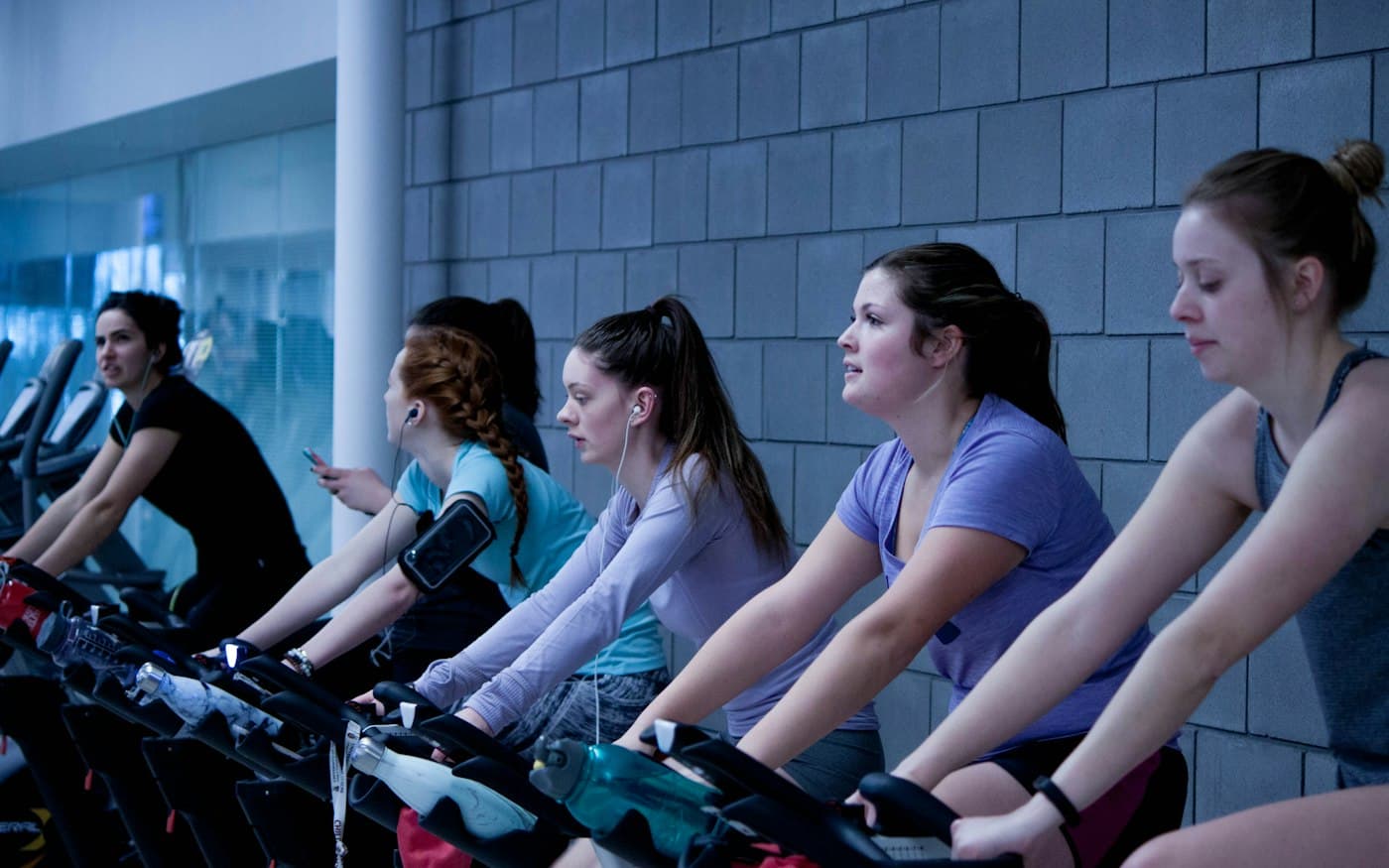
- With excess weight: Joint-friendly cardio machines such as exercise bikes or cross-trainers are suitable for getting started, while the treadmill only comes later because of the load from body weight. In strength training, joint-friendly machines are preferable.
A few practical rules help to keep the load under control. With all knee complaints, swelling is an important indicator of load-bearing capacity: if it increases, the load is reduced immediately. In yoga, the following applies to knee problems, which include osteoarthritis: never hyperextend the legs and always align the knee in the same direction as the toes. Caution is needed with hero pose, lotus pose, pigeon pose and deep squat, among others. With hip osteoarthritis, poses such as half moon, warrior III and revolved half moon are avoided, and with osteoarthritis of the cervical spine, caution is needed with inversions. You can read more about strength training in the second half of life in the article Fit over 50.
Where the limits lie: diagnosis, treatment and training
As important as movement is, training does not replace diagnosis or treatment in osteoarthritis. The tasks are clearly divided. Doctors are responsible for structural, medical diagnostics, physiotherapy for functional diagnostics and restoring function, and training for improving physical performance with a focus on health or sport. Trainers do not make diagnoses but always recommend a medical assessment if they suspect a problem.
Treatment also belongs in medical hands. In knee osteoarthritis, the first step is to reduce the load, for example with a walking stick on the opposite side. Cold for acute irritation, heat for chronic conditions and occasionally injections are added. These measures are purely symptomatic and do not tackle the cause of the osteoarthritis. If hip symptoms persist, an artificial joint is usually fitted. After that, physiotherapy follow-up treatment takes priority at first, and training in the gym only begins later. With a knee affected by osteoarthritis in particular, the rule is: people affected should know how to deal with it and what they can and cannot do, and clarify this with the specialists treating them.
Course tip from update Akademie: In their everyday work, trainers repeatedly encounter conditions such as osteoarthritis and the limitations that come with them. The Fitness- und Bewegungstrainer Advanced (fitness and movement trainer) course includes training planning for specific target groups and case studies covering medical conditions and training adaptations. As a short format, the workshop Die Pathophysiologie (pathophysiology) explores health limitations in more depth.
Frequently asked questions about osteoarthritis and training
Can you exercise with osteoarthritis?
As a rule, yes, unless a doctor has specified otherwise. Gentle movements free of pressure and pain, as well as strengthening the muscles around the joint, are considered useful in osteoarthritis and have a positive effect on the course of the disease. An important reason lies in the cartilage: it has no blood vessels and is supplied via the synovial fluid, which requires the joint to be moved and loaded. Clarify with a doctor or physiotherapist which load is appropriate in your individual case.
What is the difference between osteoarthritis and arthritis?
Arthritis is inflammation of a joint, caused for example by infections, rheumatological diseases or gout. Typical signs are pain, redness, swelling and increased temperature in the joint. Osteoarthritis, by contrast, is a degenerative joint disease: it develops through a mismatch between the load on the articular cartilage and its load-bearing capacity, often has no inflammatory component or only a very weak one, and shows itself mainly through pain that depends on position and load. Which condition is present is determined by a doctor.
How do you train with knee osteoarthritis?
The focus is on training the muscles that stabilise the knee and length training for muscles that tend to shorten. Both can improve the situation somewhat in the longer term. Movements should be gentle and free of pressure and pain. If swelling in the knee increases, the load is reduced immediately. In yoga, the rule is also: do not hyperextend the legs and align the knee in the same direction as the toes. People affected should clarify with the specialists treating them what their own knee can and cannot handle.
Why does cartilage need movement?
In adults, articular cartilage has no blood vessels. Its cells are supplied by diffusion from the synovial fluid. For enough nutrients to arrive, the joint has to be moved and loaded a lot. You can think of cartilage as a sponge that soaks itself full when the load is removed and squeezes out waste products under load. Because supply only takes place by diffusion, regeneration after injuries is severely limited.
Conclusion
Osteoarthritis develops when the load exceeds the load-bearing capacity of the articular cartilage. Unlike arthritis, the main issue is not inflammation but wear, which shows itself mainly through pain that depends on load and position. Because cartilage has no blood vessels and is supplied via the synovial fluid, it needs movement. Gentle movements free of pressure and pain and strong muscles around the joint make sense. Diagnosis and treatment remain in medical hands, and training complements them.