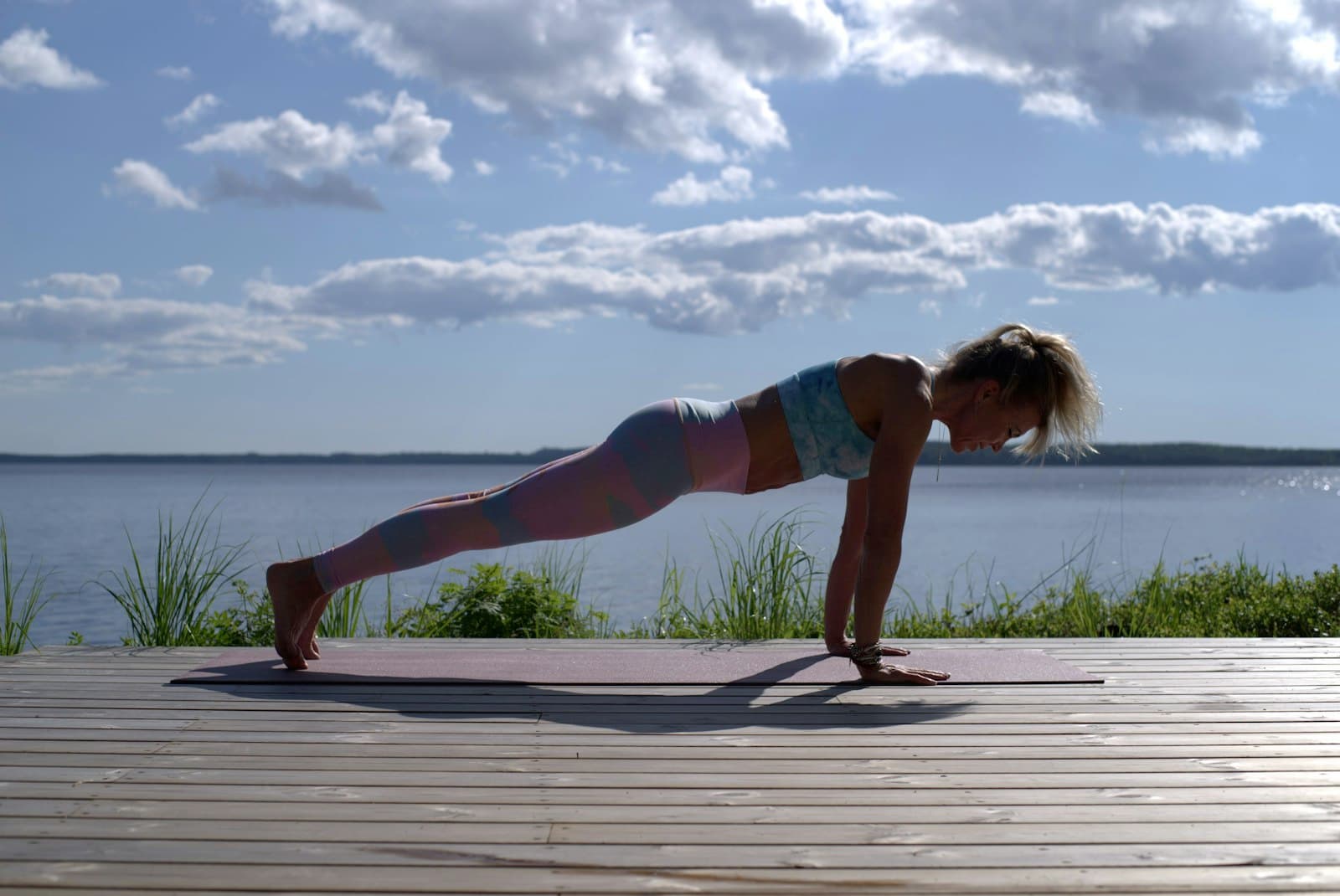
A home workout refers to training that you can carry out entirely at home – without a gym and without large equipment. It's not about replacing the gym one to one, but about giving you a flexible and practical way to integrate movement into your everyday life.
In recent years especially, the home workout has grown in popularity – not only because gyms were temporarily closed, but also because more and more people realise how efficient and varied training within your own four walls can be.
The benefits of a home workout
A home workout brings several benefits at once:
- Flexibility: you decide yourself when, how long and at what intensity you train. Whether early in the morning, during the lunch break or in the evening – you're independent of opening hours.
- Time saving: no commute, no waiting for free equipment. That way you save valuable time in everyday life.
- Cost saving: you don't need a membership and can already get started with a mat, your body weight and possibly small aids.
- Privacy: you train without distraction, in your familiar surroundings. That lowers the inhibition threshold, especially for beginners.
Also interesting: studies show that even 20–30 minutes of movement several times a week are enough to measurably improve your health. A home workout is therefore an ideal entry point if you want to regularly integrate movement into your everyday life.
Effective exercises without equipment
Even without equipment you can complete a comprehensive workout. Important basic exercises are:
- Squats and lunges train the legs and glutes and improve your functional strength and your balance.
- Push-ups and dips strengthen the chest, shoulders and arms – through variations you can adjust the difficulty.
- Pulling exercises such as pull-ups, dumbbell rows, TRX or at the table strengthen the back, shoulders and arms, and the level of difficulty can also be adjusted well.
- Plank variations strengthen the core, improve body stability and prevent back pain.
- Burpees, mountain climbers, rope skipping etc. get your cardiovascular system going and promote strength endurance.
These exercises use movement patterns that you also need in everyday life – from lifting to pushing and pulling all the way to stabilising. This makes a home workout suitable not only for fitness goals, but also for improving your performance in everyday life.

Would you like to turn your hobby into a profession too?
Discover the various training programmes of the update Akademie and qualify as a fitness trainer!
More variety with simple aids
If you want to step up your training, you can make big differences with little effort:
- Resistance bands offer variable loads and are easy to stow away – ideal for legs, back or shoulders.
- Dumbbells or kettlebells enable targeted strength training with progressive increases.
- A pull-up bar and/or a suspension trainer don't take up much space and open up numerous full-body exercises with your own body weight, which promote stability and strength at the same time.
- A gym ball or Bosu bring instability into play and thus challenge your core stability and balance.
- A skipping rope improves your coordination and endurance – a classic that can be very intense in just a few minutes.
Even with these small tools you can cover almost all training goals – from muscle building through fat loss to mobility.
Motivation and routine
One of the biggest benefits of a home workout – flexibility – can at the same time be a challenge. Because without a fixed structure it's often harder to stick with it.
Helpful tips:
- Plan your training like a fixed appointment in the calendar.
- Set yourself small, achievable goals (e.g. 3 workouts per week).
- Use training plans or apps to have structure.
- Create a fixed training environment for yourself, even if it's just a mat in the living room.
Motivation can also come through variety: play with intensity, duration and exercise selection – that way you avoid monotony and stay with it longer.
The limits of the home workout
As effective as a home workout can be, it also has its limits:
- For maximum muscle building or very specific goals, training at home usually isn't enough after a certain time, because heavy loads are missing. For the beginning, however, it can be an excellent option.
- The social aspect, such as exchange or motivation through others, falls away.
- Without targeted variation and professional coaching, the training load can stagnate – so it takes a bit of personal initiative.
- Risk of injury: if no specialist checks your technique or accompanies your training planning, the risk of poor execution or one-sided strain increases – which can lead to complaints over the long term.
This means: a home workout is ideal for staying fit, healthy and capable. If, however, you're aiming for maximum strength or muscle gains, supplementary training with larger equipment at the gym makes sense.
Conclusion: the home workout as a flexible form of training
A home workout isn't just a stopgap, but an independent and effective form of training. With creative exercises, simple aids and a bit of structure, you can reach your fitness goals even without a gym. Whether you want to stay healthy, get stronger or feel better in everyday life – the home workout offers you the necessary flexibility and efficiency.