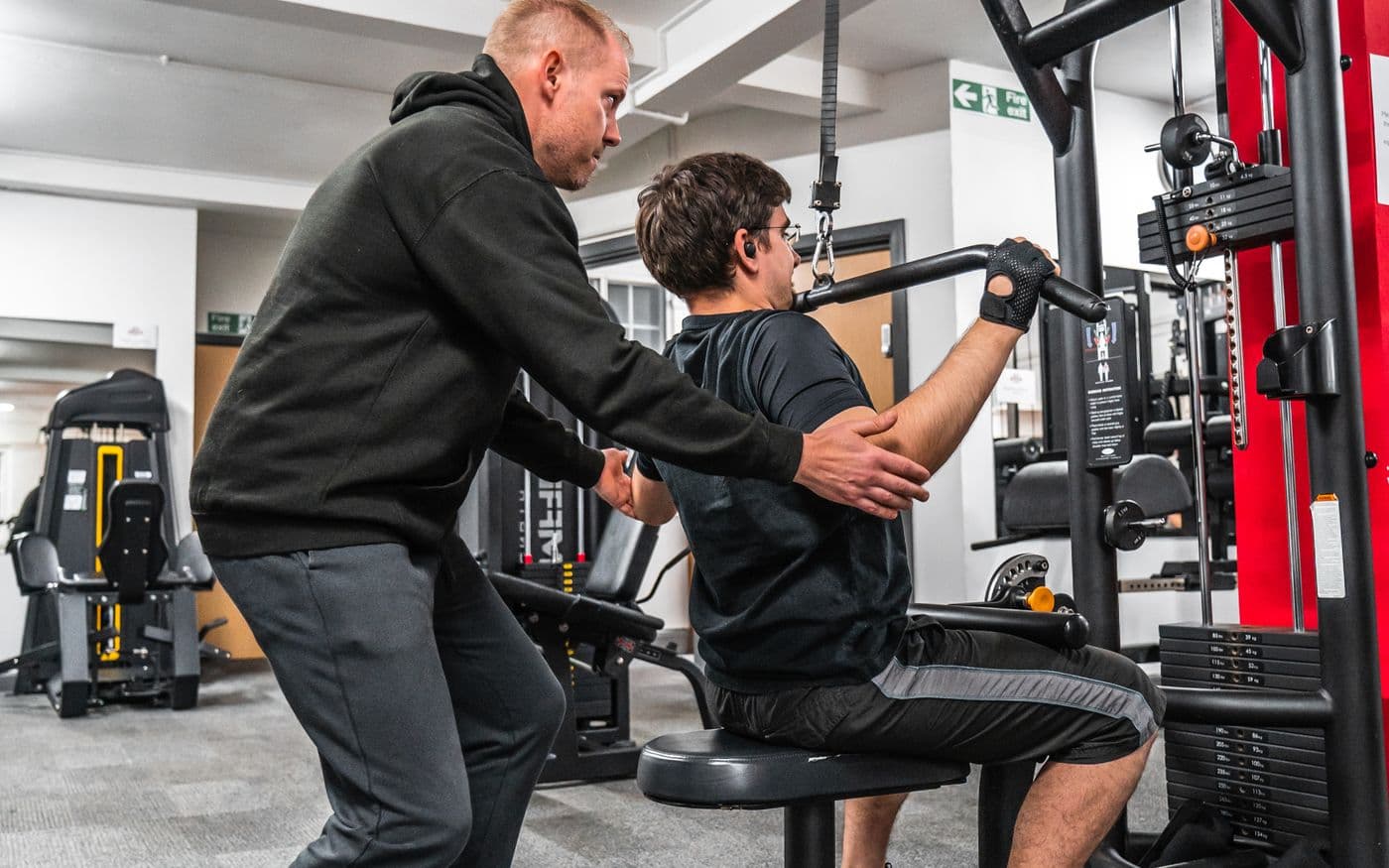
Most training programmes in the fitness centre are put together week by week. You see how the client responded to the last session, adjust, carry on. That works for a while – and then runs into a limit that has nothing to do with exercise selection. Training planning means thinking through the structure of the training in advance: setting out goals, concept, structure, content, methods and organisation for a defined period. Anyone who never thinks beyond the current week cannot plan progression, only establish after the fact whether it has occurred.
Why planning is thought through in months
According to training theory, a training programme is a binding working guideline for steering the training process over a defined period. In the fitness sector, medium-term planning is the usual approach: after two to three months there should be a refresher session in which the goals are redefined, a new health evaluation is carried out and goal attainment is reviewed.
What is interesting is the reasoning behind the length of this window. Shorter training phases are rather rare, longer ones are in principle not intended – because then often not all the criteria for progression are observed and, as a result, no increase follows. The rhythm is therefore not a sales interval but a consequence of the principle of progressive overload. A programme that runs unchanged for half a year is, as a rule, a programme that is no longer increasing.
At the same time, planning is never finished. Certain circumstances change again after the planning – through a change of goal, illness, absences, changes of schedule – and the process is therefore shaped by ongoing adjustments. This matches the planning cycle: the goals are set in the evaluation conversation, the training steps are planned from them, implemented by the guest in the period that follows, reviewed in the refresher session, analysed for sources of error and planned anew.
The three cycles
Three periods are generally distinguished for the planning of training. They are nested within one another – the larger one consists in each case of several smaller ones.
Macrocycle: long-term planning
A macrocycle is made up of several mesocycles and covers long-term training planning up to a period of one year. It can be divided into several phases that differ greatly in terms of load density. In competitive sport the macrocycle often starts with the phase of developing sporting form, also called the preparation phase, gradually moves into the phase of relative stabilisation – the competition phase – and ends with a phase of temporary loss, the transition period. Depending on age and performance level, the structure of a macrocycle differs considerably.
For work in the fitness centre, the macrocycle is the level on which you keep a client's year in mind – the summer break, the skiing holiday, the spring race, the busy period at work in autumn. It is rarely written down explicitly, but it determines which mesocycles make sense in the first place.
Mesocycle: medium-term planning
The mesocycle is the actual working level in the fitness centre – the window that ends with the refresher session. Training theory describes a sequence of working steps for this which doubles as a usable checklist for the planning conversation.
- Setting goals: at the beginning of every medium-term plan, achievable goals should be formulated – achievable, but also demanding.
- Requirement profile and target value: for this, the sport being practised has to be analysed. The aim is to find out which conditional, emotional, intellectual, coordinative and mental abilities are required in order to reach the goals that have been formulated. Such analyses have already been published for many target groups.
- Status assessment, actual value and diagnosis: here the current values of performance capacity are recorded, along with an analysis of resilience and of the training means and methods used so far. The aim is to establish which progress was achieved with which training stimuli – and what influence the general conditions had.
- Balance and target-actual comparison: the aim is to find weaknesses and strengths. From this, the development potential in the individual areas can be estimated.
- Training concept: it should remove the weaknesses that have been found and bring the strengths out more clearly. First comes the rough plan with the choice of training content and the key points of the season plan; after that, priorities are set on the basis of the development potential and the intensity of the training phases is determined.
- Evaluation: the evaluation instruments and status checks are already determined during medium-term planning – that is, it is decided which information you want to collect and with which methods.
The last point is the one most frequently missing in practice. Anyone who only considers after two months how progress might be measured has no baseline data. According to training theory, status assessments are of great relevance for exactly this reason: they make progress measurable and thereby create the conditions for progressive overload in the first place.
Microcycle: short-term planning
A microcycle is the combination of a few training sessions and covers a few days up to a week. Compared with medium- and long-term planning, further circumstances are already known here, which makes it possible to adjust the load and to work out the plan in more differentiated form.
An important part of this planning is the timing of demanding training sessions in the areas of speed strength, technique or coordination. For optimal training success, these sessions require a rested organism. In the competition phase, short-term planning makes it possible to respond to intensive competitions and reduce the load.
Interactions within the training week
When putting a week together, three kinds of interaction between the training sessions have to be taken into account: the influence of one session on the next session of the same form, for example strength on strength; the influence of one session on the training stimulus of a session already completed, for example endurance on a preceding session; and the influence of one session on another, subsequent session and the training stimulus to be expected there, for example flexibility.
Within the individual session, the optimal sequence of loading additionally applies: first coordinatively demanding content such as speed, technique and coordination training, then strength or muscle training, and endurance training last. For ambitious athletes it is an advantage to train only one factor of performance capacity per session, since the effect of strength training is decisively reduced by endurance training performed afterwards. How this order is translated into a concrete weekly plan is shown in the article Creating a training programme: from the goal to the training week in six steps.
Individualisation: the fitness compass as a steering instrument
Cycles alone do not yet make a good programme. When individualising training sessions, the goals and needs as well as the possibilities and limitations of a training guest always have to be taken into account. The compass of fitness components serves to steer the training content: strength, endurance, flexibility, coordination and relaxation.
For many training guests, strength training is at the centre and is therefore given the highest priority. Depending on the goal, the further components are then selected and planned. Important for practice: it is entirely possible for only two or three of the components to be covered in a training programme if that corresponds to the training goals. So a programme does not have to serve all five fields in order to be complete.
Three orientations, three planning logics
Three groups of trainees can be distinguished on the basis of their goals. The health-oriented guest primarily pursues health goals, wanting to improve or maintain their health; pain or everyday limitations often play a substantial part in their coming to a fitness centre. This group often consists of older people, but also includes guests of other age groups – the older lady who wants to carry her shopping bags on her own again, say, or the office worker with back pain.
The fitness-oriented guest usually has no health complaints and primarily wants to improve aesthetically. For the motivation of this group, visible progressive training progress is of primary importance; success is measured above all in gains in muscle mass or reductions in body fat. That has an immediate consequence for planning: here, short, visible interim goals and documented status assessments are not an extra but the engine of adherence.
The performance-oriented guest is the rarer group in the fitness centre. Elite and recreational athletes want to improve their individual conditional factors specifically in order to do better in their sport. They measure their progress with a wide variety of test procedures and often pursue longer-term goals. The training methods are usually difficult to implement in a fitness centre – this kind of training generally takes place in specialised sports centres.
This division is a simplification, and training theory says so itself: individual training goals are thereby reduced to a particular pattern and never fully reflect the specific wishes of the guest. The target group gives you a planning logic, not the plan itself. How to handle your clients' goals so that they carry rather than weigh down is covered in the article Between motivation and pressure.
What cycling has to do with recovery
Every cycle plan is at the same time a recovery plan. Adaptation effects largely take place during the recovery phase after a successfully completed session, which is why recovery is at least as important as the load. On top of that, adaptation effects take differing amounts of time: functional adaptations happen relatively quickly, structural ones often take longer, and the active musculoskeletal system recovers faster than the passive one. That is precisely why progression needs months and not weeks. For more depth on this: The importance of recovery in training.
Course tip from update Akademie: Anyone who builds programmes across macro-, meso- and microcycles, draws up requirement profiles and analyses status assessments is already working at the level of performance diagnostics. That is exactly where the Athletikcoach course begins, going deeper into planning for performance-oriented goals. If you first want to consolidate the planning craft for the training session itself, the workshop Die optimale Gestaltung von Trainingseinheiten is the direct way in.
Frequently asked questions about periodisation and cycling
What is the difference between macrocycle, mesocycle and microcycle?
The macrocycle is the long-term plan, covering up to a period of one year, and consists of several mesocycles. The mesocycle is the medium-term level on which goals, requirement profile, status assessment, balance, training concept and evaluation are determined. The microcycle covers a few days up to a week and is made up of individual training sessions.
How long should a training programme in the fitness centre run?
In the fitness sector, medium-term planning is the usual approach, with a refresher session after two to three months. There the goals are redefined, a new health evaluation is carried out and goal attainment is reviewed. Longer phases are in principle not intended, because then often not all the criteria for progression are observed and no increase follows.
Does a training programme have to cover all five fitness components?
No. The compass with strength, endurance, flexibility, coordination and relaxation serves to steer the training content, with strength training at the centre for many guests. It is entirely possible for only two or three components to be covered if that corresponds to the training goals.
Why is it not enough simply to adjust the programme from week to week?
Because progression cannot be steered without a defined period. In training planning, goals, concept, structure, content, methods and organisation are set out in advance for a defined period, and status assessments make the progress measurable. Ongoing adjustments are part of it, but they do not replace the structure.
How do I take account of interactions between training sessions?
Consider three influences: that of one session on the next session of the same form, that on the stimulus of a session already completed, and that on a subsequent session. Demanding content in speed strength, technique or coordination requires a rested organism and therefore belongs on rested days. Within a session, the order is coordinatively demanding first, then strength, then endurance.
Conclusion
Periodisation is not a luxury reserved for competitive sport but the only way to make progression plannable. The three cycles give you three perspectives on it: the year, the quarter and the week. In the fitness centre the work lies predominantly on the middle level, with a refresher session after two to three months and an evaluation that you determine at the outset rather than inventing at the end. Individualisation does not mean doing something different for everyone, but weighting the fitness components according to goal, possibilities and limitations – even if only two or three of them end up in the programme.