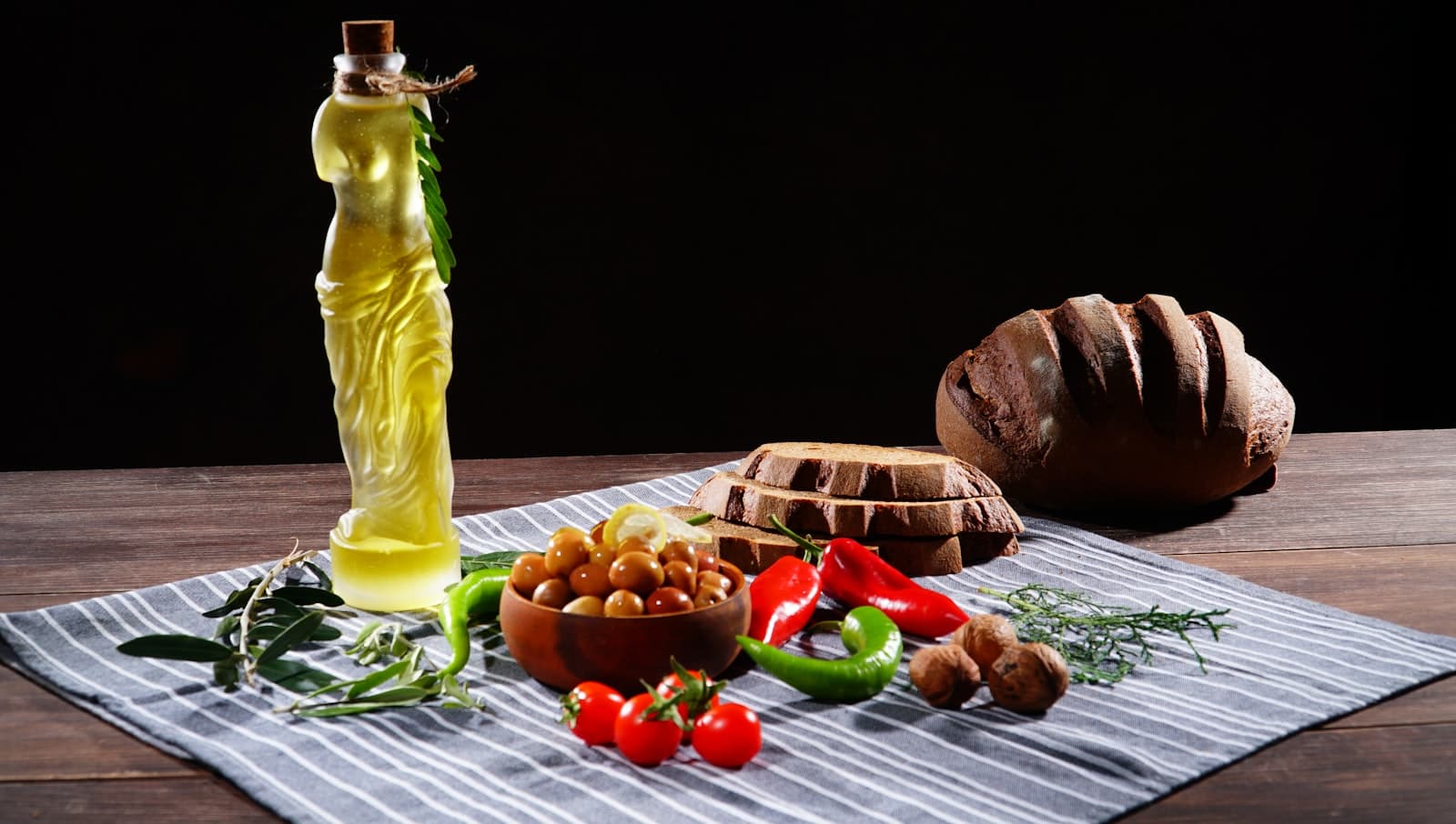
Hardly any dietary pattern has been studied as often as the Mediterranean one — and hardly any performs so reliably well. It appears in recommendations on cardiovascular disease, it holds up over years in weight studies, and it manages without a list of prohibitions. That is exactly what makes it interesting for everyone who is not looking for a diet but for a way of eating they will still be practising in five years. In this article we clarify what defines it, what update Akademie's course materials say about the evidence, how it differs from keto, LOGI, paleo or carnivore — and how you implement it with Swiss foods.
What the Mediterranean diet really involves
First the clarification: it is not about pizza, pasta and tiramisu. What is meant is the traditional eating pattern of the Mediterranean region, and its most striking feature is the fat share. It lies considerably higher than in low-fat concepts, but is covered overwhelmingly by monounsaturated fatty acids from olive oil and polyunsaturated fatty acids from fish and nuts. Saturated fatty acids from fatty meat, sausage products and butter play a small role — and that is relevant, because a high intake of saturated fatty acids worsens blood lipid values and raises the risk of vascular disease and type 2 diabetes.
The second point is the plant-based foundation: plenty of vegetables, fruit, pulses, wholegrains, plus nuts and seeds. From this follows a high intake of dietary fibre — and that is part of what decides whether you keep a dietary change up.
The load-bearing building blocks
- Olive oil as the main fat source: carrier of the monounsaturated oleic acid. It keeps cell membranes functioning and serves as a source of energy.
- Vegetables and fruit in quantity: the Swiss food pyramid recommends five portions of 120 grams a day — three vegetables, two fruit.
- Pulses and wholegrains: chickpeas, lentils and beans supply protein and dietary fibre and are among the carbohydrate sources with a low glycaemic index; with cereal products, wholegrain versions are to be preferred.
- Fish instead of sausage: oily fish supplies EPA and DHA directly — in far greater amounts than the body can produce them from plant alpha-linolenic acid. More on this in the article on omega-3 fatty acids.
- Nuts and seeds: 20 to 30 grams daily, unsalted.
- Little processed meat: sausage products are one of the main sources of saturated fatty acids.
What the evidence says
Here it becomes concrete. In update Akademie's course materials there is a sentence that defuses many diet debates: low-carb diets as well as a healthy calorie-reduced mixed diet — that is, the Mediterranean diet — are superior to low-fat diets, both in the short and in the long term.
The way things develop is revealing. In the study cited, the low-carbohydrate variant led to the greatest weight loss in the first two years. Over six years, however, weight was regained more there than with the calorie-reduced Mediterranean diet — which is why in the long term the Mediterranean variant is judged the most effective. On the metabolic parameters, that is cholesterol values, blood lipid profile and blood sugar control, the Mediterranean and low-carbohydrate diets were likewise superior to the low-fat one.
For the heart and blood vessels, the Mediterranean diet together with the DASH diet counts as one of the two best-researched concepts. One observation on this is interesting: a newer form of the DASH diet that moves closer to the Mediterranean diet — fewer carbohydrates, more plant fats — shows better effects on cardiometabolic parameters than the classic, fat-reduced version. What role nutrition plays with an existing illness is explored in more depth in the article on cardiovascular disease. With diagnosed illnesses, a change of diet belongs under medical supervision.
And the much-cited anti-inflammatory effect? The mechanism behind it is unspectacular but well documented: polyunsaturated fatty acids are the starting substance for eicosanoids — hormone-like substances that act, among other things, on blood pressure, inflammatory processes, the immune system and the clumping of blood platelets. A favourable ratio of omega-6 to omega-3 fatty acids, such as this dietary pattern brings with it, is therefore more than a detail.
Why it is sustainable in everyday life
Keeping it up decides the success of every dietary change, and three factors influence that: palatability, everyday practicality and satiety. This is exactly where the Mediterranean diet is strong. Fat is an important carrier of flavour and, alongside protein, contributes substantially to satiety — a plate with olive oil satisfies differently from the same plate without. Dietary fibre from vegetables, fruit and wholegrains additionally increases food volume and reinforces the feeling of fullness.
On top of that: there are no forbidden foods, no measuring devices, no phase plans. If you eat out or are invited somewhere, you do not have to explain anything. That sounds banal, but it is the reason why this dietary pattern performs better in long-term observations than more restrictive concepts that deliver more impressive numbers in the short term.
Eating Mediterranean-style in Switzerland
You need neither a sea nor imports for it. The Swiss food pyramid expressly recommends seasonal and regional products — and that can be reconciled well with the Mediterranean pattern:
- Oil: two to three tablespoons (20 to 30 grams) of vegetable oil daily, of which at least half should be rapeseed oil. Rapeseed oil is the Swiss classic and, alongside monounsaturated fatty acids, supplies the essential alpha-linolenic acid. Olive oil comes on top for salads and cold uses.
- Vegetables: cabbage in winter, beetroot, carrots, leek, kale — in summer courgettes, tomatoes, beans. Five portions are achievable with local produce all year round.
- Pulses: lentils and peas replace the meat on two to three days per week. The SGE recommends reducing meat and sausage consumption anyway.
- Nuts: locally grown walnuts cover the daily portion and likewise supply alpha-linolenic acid.
- Fish: with fish, importing is realistic — here it is worth paying attention to origin and sustainability.
Distinguishing it from other dietary patterns
The Mediterranean diet lies, so to speak, in the middle of the field — and that is its strength. It differs from the ketogenic diet in its moderate, not radical, reduction of carbohydrates: wholegrains and pulses stay on the plate. The LOGI approach shares its view on fat quality — olive and rapeseed oil instead of fat reduction — but lowers the total amount of carbohydrates more markedly and puts the glycaemic index at the centre. The paleo diet cuts out grains and pulses entirely — that is, precisely those groups that are load-bearing in the Mediterranean pattern. Furthest away is the carnivore diet, which cuts out the plant part completely.
Closer are the plant-focused patterns: a vegetarian diet overlaps in large part but does without the fish — which means EPA and DHA are only supplied indirectly via alpha-linolenic acid or via algae. The same applies all the more to the vegan diet, in which vitamin B12 additionally has to be supplemented. What all health-promoting patterns have in common is in any case greater than their differences: plenty of plant foods, little that is heavily processed, good fat quality.
Course tip from update Akademie: If you want not just to look such dietary patterns up but to judge them and explain them to clients, you will find the foundation in the Ernährungscoach programme at update Akademie. It covers the Swiss food pyramid, the nutrients including fatty acids, the common alternative dietary patterns as well as evidence-based practice — that is, the question of how to check what studies say instead of simply adopting it.
Frequently asked questions about the Mediterranean diet
Do you lose weight with the Mediterranean diet?
Only with a negative energy balance — that is the precondition for any reduction of fat mass. The calorie-reduced Mediterranean variant performs better in the long term than low-fat diets, among other reasons because it is more satiating and easier to keep up.
Isn't that much fat unhealthy?
What is decisive is the type of fatty acids, not the amount alone. A healthy adult should take in around 1 gram of fat per kilogram of body weight; what is problematic are high shares of saturated and above all industrially produced trans fatty acids, not olive oil or nuts.
Is wine part of it?
In the food pyramid, alcohol counts as an indulgence and should be consumed in moderation. A healthy lifestyle expressly includes avoiding excessive alcohol consumption — the Mediterranean diet works entirely without wine.
Is the Mediterranean diet also suitable for athletes?
Yes, with additional portions: per hour of sport, one additional portion from the cereals, potatoes and pulses level as well as half a portion of oils and nuts, plus the corresponding fluid intake.
How quickly does an effect show?
With weight and blood values, changes are to be expected over weeks to months, not over days. The recommendations of the food pyramid do not have to be met daily anyway but over the long term — for instance across the course of a week.
Conclusion
The Mediterranean diet comes out ahead in studies not because it contains a secret but because it combines two things that rarely come together: a favourable nutrient composition — plenty of plant foods, high-quality fats, little processed meat — and an everyday reality in which you actually keep it up. That is precisely why, in update Akademie's course materials, it is placed ahead of low-fat diets in the short term as well as the long term. With rapeseed oil, seasonal vegetables and pulses it can be implemented in Switzerland without any fuss.