Hardly any question is asked so often on the training floor and answered with reasons so rarely: machines or free weights? Most of the time the discussion ends up at taste, habit, or whatever the last trainer said. Yet there is a more factual level, and it comes from physics. Once you understand what torque is, why strength machines have a cam built into them and what actually happens during a barbell biceps curl, you no longer need an opinion – you have a justification.
What biomechanics actually contributes to training
Biomechanics is understood to mean the study of the behaviour of biological systems from the point of view of mechanics. For work on the training floor it is mainly about the musculoskeletal system – the locomotor apparatus – and especially about dynamics: the analysis of forces as the cause of movements.
During every movement, various forces act on the body. For steering a training programme it is decisive to understand where and how the force should ideally act – and where it should not. The principles of biomechanics allow a body status to be drawn up and individual training specifications to be derived from it. That is the difference between «that exercise looks odd» and «the lever is too long».
Force, work, power – and above all torque
Four quantities are enough to bring order to most discussions on the training floor. Force is the physical quantity that can accelerate or deform a body. Work is the energy transferred to a body by a force along a path – the product of force and distance. Power is the work performed within a given span of time.
The fourth quantity is the most important one for strength training: torque. It describes the turning effect of a force and plays the same role for rotational movements as force does for linear ones. It is calculated as the product of lever and force, where the lever is the distance from the pivot to the point at which the force is applied.
In the human body, torques play a central role because all movements arise from muscular activity at a joint. The joint forms the pivot, and the point at which the resistance is applied – the palm of the hand when holding a dumbbell, for instance – defines the lever. From this follows something that tends to be overlooked in everyday practice: the number on the weight plate is not the load on the muscle. Even when only your own body weight is being moved, enormous torques already act in the ankle joint when you rise onto your toes – they arise from the often small and therefore unfavourable levers of the muscles in the body.
A digression on the cam: why strength machines have a cam disc
Anyone who has ever seen the casing of a strength machine opened up knows the component: an often elliptical disc connected to the machine's axis of movement. This cam transfers the load of the training weight via the axis to the pad of the lever arm that you move. It is the real reason a machine feels different from a dumbbell.
What the cam compensates for
Every muscle develops more force at certain joint angles than at others. If a muscle were trained on a machine that offered it the same resistance at every angle of the movement, the theoretical consequence would be overload at some angles and underload at others. The cam is meant to ensure that the muscle is loaded as evenly as possible throughout the entire movement.
Technically this works through the lever. The training weight is transferred by a cable or a belt to the outer edge of the cam disc. The distance from the point at which the weight is applied to the disc to the pivot determines the length of the lever arm with which the weight pulls – that is the load arm. The length of the lever arm against which you work, by contrast, determines the effort arm. According to the law of the lever, force × effort arm = load × load arm, less force has to be applied when a longer lever arm is available – you know the principle from the car jack. Because the disc is not round but eccentrically shaped, this ratio changes across the course of the movement, and with it the resistance you feel.
Where the idea comes from
Arthur Jones had observed in Africa that lions lie around apparently lazily almost all day and nevertheless have highly capable muscles – on the hunt they suddenly develop superpowers. To him it looked as though a short period of high-intensity effort was enough. In the 1960s, and without scientific verification, he developed his Nautilus machine from this: the first modern strength training machine of all. Nautilus machines are largely constructed so as to isolate muscle groups; the resistance is applied only to the part of the limb that is also moved by the muscle in question.
In doing so, Jones had correctly recognised that many barbell exercises offer full resistance only across a limited range of motion. The prime example is the biceps curl: at the start of the movement there is practically no resistance, the force curve rises until the forearms are parallel to the floor, and then falls away again. In the end position you can hold a loaded barbell almost effortlessly. The cam disc was meant to remedy exactly that and to guarantee constant resistance across the entire range of motion. Because its shape is reminiscent of a nautilus shell, Jones named his company after it.
What follows from this for free weights
The honest answer is: free weights are not worse, they have a different resistance curve. Sometimes that is a disadvantage and sometimes it is exactly the point. The disadvantage is the uneven curve across the course of the movement, as the biceps curl example shows. The advantage is the freedom to adapt the movement: if an exercise needs to be routed past an irritated structure, a free weight can be used instead of a machine, or the exercise can be modified. After knee injuries, too, strength training of the lower extremity with free weights is preferable to machine training in the fitness setting – provided the client has mastered clean technique.
And that is exactly the price: technique. A squat with the 20-kilo barbell demands feet shoulder-width apart, a straight back, the buttocks pushed back and a trunk stabilised throughout – every requirement one more source of error than on the guided machine. Anyone who has not mastered this technique is not training more freely but less controlled. A broader treatment of the comparison can be found in the article Machines or free weights: which is better for your training?, and closely related to it is Isolation exercises vs. compound exercises.
The rule that applies to both sides
In muscle training the aim is not to move as much weight as possible but to fatigue the muscle as much as possible. As much of the resistance as possible should therefore act on the muscle, and the guest should seek the resistance out rather than avoid it – on the barbell just as on the machine. How closely this is tied to time under tension and exhaustion is shown in the article Time under tension and muscular exhaustion.
The same logic is contained in the general positional principles: a position that is as natural as possible, the head in line with the spine, stabilised wrists, shoulders low and back, a trunk stabilised in every exercise and the largest possible range of motion – health limitations may be the limiting factor.
The instruction makes no distinction
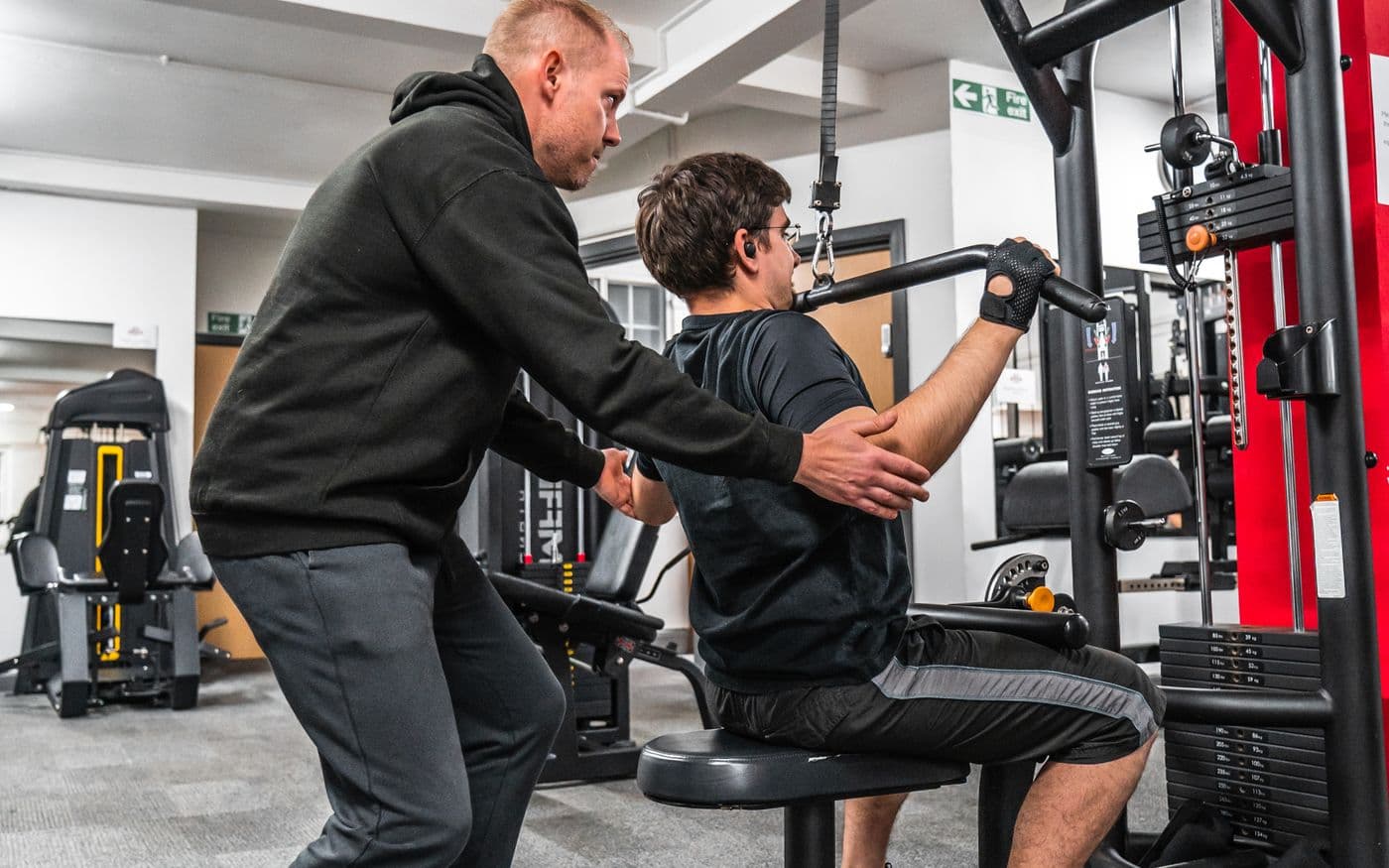
What is remarkable is what is not separated in the course: the instruction procedure. It comprises fourteen steps – from naming the machine, through naming the muscles being worked without technical terms, demonstrating the movement and checking the starting position, to the first repetition in slow motion and noting the settings, weight and number of repetitions on the training programme. This procedure can be applied to all exercises – it makes no difference whether you are instructing a machine-supported exercise or one with free weights. Two points are particularly relevant in everyday practice: training to muscular exhaustion means training until anatomically correct execution of the movement is no longer possible – and caution is called for here with beginners. And all machine settings belong on the training programme without exception.
How you decide within the training programme
The selection follows no preference for equipment but a structure. The simplified muscle model serves as the basis of the numbering system for strength machines: 1 to 9 stand for the lower extremities, 10 to 19 for the upper extremities, and from 20 for the trunk. This is extended by the functional circles, from control through body stabilisation and locomotion to object control. In a balanced training programme, two to three muscles from each of functional circles II to IV should be taken into account; depending on the training goal, further exercises are added. How to build a training week from this is shown in the article Creating a training programme: from the goal to the training week in six steps.
Why several exercises for the same muscle at all? If a muscle is worked with a particular exercise to the point of voluntary exhaustion, all the motor units that can be recruited for that movement are called upon. Performing exactly the same exercise several times therefore hardly leads to the recruitment of additional motor units – for that, as many as possible of the anatomical functions of the target muscle have to be exhausted. This is precisely where machine and free weight lose their rivalry: they are two routes to different functions of the same muscle. Before every extension there are three questions: does the exercise serve your guest's main goal? Does it create additional benefit for reaching that goal? Is it definitely preferable to the alternatives?
Course tip from update Akademie: Anyone who wants not only to demonstrate movements but to justify and correct them needs this physical foundation in their head. In the Fitness- und Bewegungstrainer Basic course, biomechanics, equipment knowledge and the complete instruction procedure are compulsory material, including the exercise portfolio for machines and free weights. If you are specifically interested in the physical part, it is also available as a standalone workshop, Biomechanik – das physikalische Verständnis von Kraftgeräten und -übungen.
Frequently asked questions about machines and free weights
What is a cam on a strength machine?
A cam is an often elliptical disc connected to the axis of movement of the strength machine. It transfers the load of the training weight to the pad of the lever arm that you move. Because it is not round, the ratio of load arm to effort arm changes across the course of the movement – and with it the resistance.
Why does a machine feel more even than a dumbbell?
Every muscle develops more force at certain joint angles than at others. The cam is meant to ensure that the muscle is loaded as evenly as possible throughout the entire movement. Many barbell exercises, by contrast, offer full resistance only across a limited range of motion, which is particularly clear in the biceps curl.
Are free weights unsuitable for beginners?
Not as a matter of principle, but they demand more technique. Free weights make sense once clean technique has been mastered, and guided machines make getting started easier. What matters in both cases is the instruction procedure, and with training to muscular exhaustion particular caution is called for with beginners.
What is torque in training?
Torque describes the turning effect of a force and is the product of force and lever. In the body the joint forms the pivot, and the point at which the resistance is applied determines the lever. That is why the weight loaded on its own says little about how heavily a joint is actually loaded.
How many different exercises does a muscle need?
If a muscle is worked to voluntary exhaustion, all the motor units that can be recruited for that movement are called upon. Performing the same exercise several times therefore brings hardly any additional units. It makes more sense to cover as many as possible of the anatomical functions of the target muscle through different exercises.
Conclusion
Biomechanically, the question «machine or free weight» is not an either-or question but a question of the resistance curve. The cam exists because the force of a muscle varies across the joint angle and a constant resistance would overload it in places and underload it in others. Free weights do not provide this compensation, but they can be adapted and they cover other functions of the same muscle. The same rule remains decisive: fatigue the muscle rather than move weight – with a technique that you can instruct and correct.