Tennis elbow and golfer elbow – two terms everyone has heard of and which are nevertheless almost always mixed up. Yet the difference is simple and lies exclusively in the anatomy: one complaint sits on the outside of the elbow, the other on the inside, and they affect two different muscle groups of the forearm. For the work on the training floor this is more than a clarification of terms, because the two react to different movements. What they have in common: diagnosis and treatment belong in medical or physiotherapeutic hands – your part is the training around it.
Two names, one pain syndrome
The technical term for all of this is epicondylitis. Epicondylitis is a descriptive pain syndrome of the radial or ulnar elbow – that is, of the outer or the inner side. It occurs chronically and is acquired, and it is regarded as treatable. A general distinction is made between two pain syndromes, and the popular names say nothing about the sport in which they arose. Most of those affected whom you meet in the gym have played neither tennis nor golf.
Epicondylitis lateralis – the tennis elbow
This is an overload of the hand extensors, that is, the extensor musculature of the forearm. These muscles originate on the outer side of the elbow, and that is exactly where severe pain occurs. Involved are all movements in which the wrist is extended or stabilised against a resistance – from gripping and holding through pulling movements to working with a mouse or a screwdriver.
Epicondylitis medialis – the golfer elbow
This is an overload of the hand flexors, that is, the flexor musculature of the forearm. These muscles originate on the inner side of the elbow, and that is where the severe pain arises. The cause is often overuse of this muscle group. Typical are forceful gripping, firm holding and everything that flexes the wrist against resistance.
The memory aid is therefore unspectacular but reliable: extensor musculature – outside – tennis elbow. Flexor musculature – inside – golfer elbow.
How it comes about
The overuse leads to an inflammation of the tendon attachment. There are three causes, and all three are easy to recognise in everyday fitness work: poorly developed technique, the wrong equipment and overloading, for instance through a short-term increase in training times. Typical here are training camps, courses and holidays – in other words, those phases in which suddenly a good deal more training is done than usual.
Translated to the training floor this means: the trigger is not the individual exercise but the jump in volume. Anyone who trains twice a week for months and then daily for a week is changing exactly the variable that is the cause. The same applies to the grip: if a technique is not solid and the wrist takes over the work that should actually come from the shoulder, the load ends up where it does not belong.
At this point it is worth looking at a principle from machine instruction that is rarely mentioned in connection with the elbow: the wrists are stabilised, and the grips are generally held loosely – except in pulling exercises. Anyone who permanently clamps every bar keeps the forearm musculature under tension throughout the whole set, even though it is not the target muscle at all.
What happens in treatment – and which part of it concerns you
Treatment begins by reducing the load. In addition there is massaging out tension and consistent stretching. These measures are accompanied therapeutically; they are not your responsibility, but you should know that they are running so that your training does not work against them. How stretching and length training differ is explained in the article Stretching vs. length training.
The most interesting point concerns the strengthening of the forearm musculature. Here it has so far been shown several times that slow, eccentric movements with relatively heavy weight when training the affected muscle groups have a favourable influence on the tendon attachment and the tendon. This is remarkable because it contradicts the first intuition: the irritated area is not simply immobilised but loaded in a targeted and slow manner – in the yielding phase of the movement. What “slow” and “relatively heavy weight” mean in the individual case is determined by the treating specialist, not by the training programme. If you want to refresh the types of contraction behind this, the article Concentric, eccentric, isometric: muscle contractions in training explained will help.
The other elbow pain: bursitis olecrani
Not every elbow pain is an epicondylitis. Bursitis olecrani is an irritation of the bursa of the elbow and is usually triggered by a fall onto the elbow or by repeated strong compression – for example by leaning heavily on it. It can occur acutely and traumatically or chronically and repetitively.
The picture is clear: there can be massive swelling over the olecranon, a soft thickening the size of an egg over the tip of the elbow. The elbow is extremely sensitive to pain and reacts with severe pain to pressure, for instance when leaning on it; the entire area can be strongly reddened. In this case it is advisable to consult a doctor – this is not a situation in which you adapt the training and wait and see.
Treatment is with pain-relieving and anti-inflammatory medication and possibly even with antibiotics; in some cases the bursa is removed surgically. The inflammation usually lasts around one to two weeks. During an acute inflammation, training of the upper extremities is to be refrained from. After an operation the break lasts four to six weeks, after which training can be resumed without restriction; if possible, the elbow should not be loaded directly with pressure. Prophylaxis of the non-traumatic form consists in recognising the first symptoms and acting accordingly, that is, avoiding pressure.
Which exercises in the gym are affected
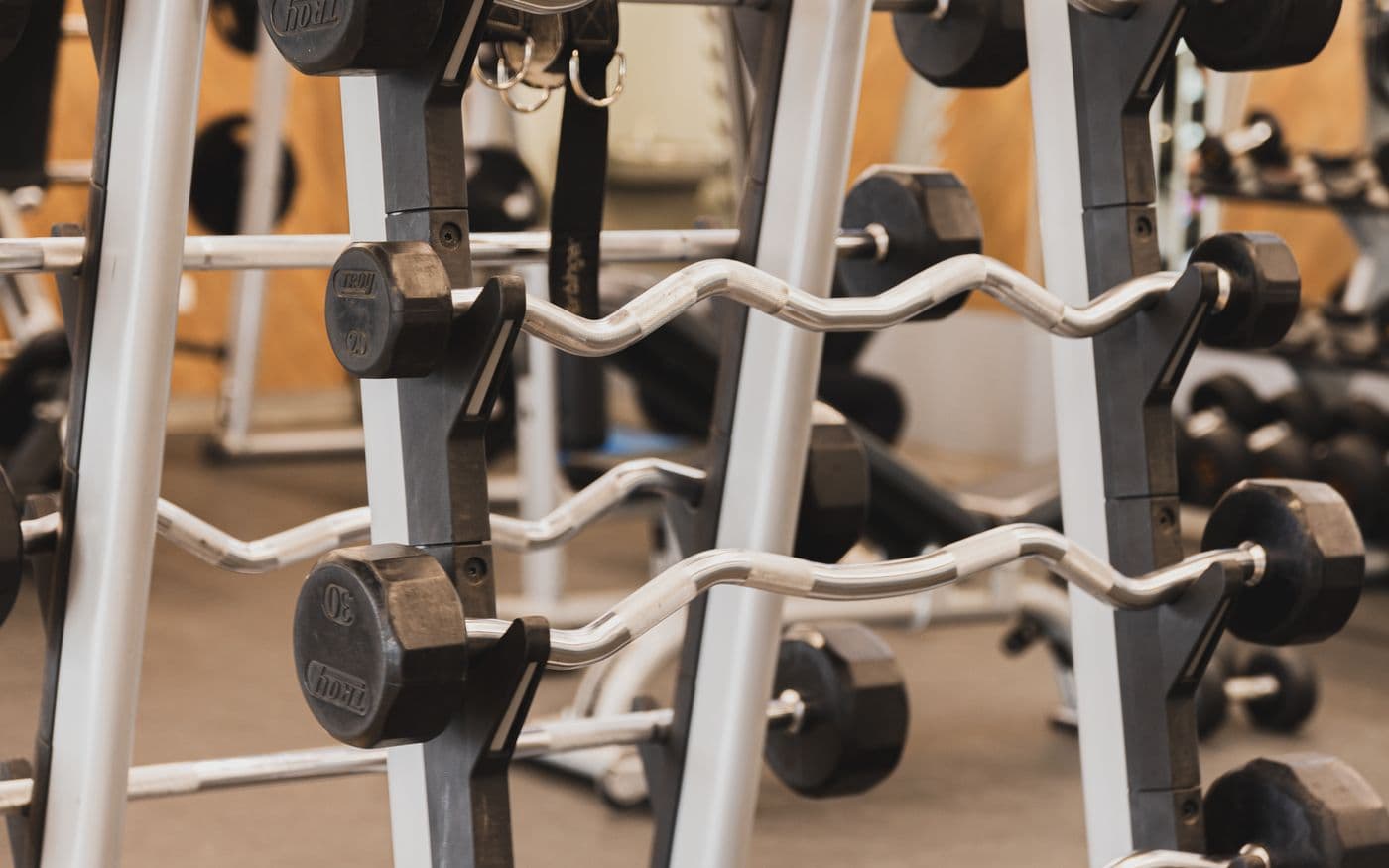
The exercise portfolio of the update Akademie carries a caution note with every exercise. “With elbow complaints” appears there for a whole series of exercises, and they are spread across several muscle groups: in pressing exercises such as the bench press on the flat bench and the chest press with dumbbells, in pulling exercises such as barbell rowing, and throughout the arm exercises – triceps on the cable, overhead triceps with a dumbbell, kickback and biceps with the EZ bar.
The pattern behind it is more useful than the list: affected are exercises in which the elbow joint is the moving pivot or has to be stabilised under load. So if a guest complains of elbow pain, that is where you look first – and not at the leg exercises.
What you adapt and where your role ends
The update Akademie trains trainers, not therapists. Whether pain on the outer side of the elbow is caused by an epicondylitis lateralis or by something else is not decided by any observation on the training floor. What you can do is clearly defined: take complaints seriously and document them, work towards a medical assessment in the case of swelling, redness and severe pressure pain, do not train the upper extremity during an acute inflammation, avoid jumps in volume and check the technique – in particular grip pressure and wrist position. And after the assessment you work within what has been cleared by the doctor or the physiotherapist.
What you do not do: set up an eccentric rebuilding programme for an irritated tendon on your own, “train away” the pain or treat a swelling as a training state. In terms of prevention, what pays off is what is good training work anyway – cleanly built-up volume and a technique that does not make the wrist the secret main load. The article How your mobility training can prevent injuries fits in here.
Training tip from the update Akademie: anyone who supports guests with complaints needs the clinical pictures in a structured form – including the question of when the training ends and the assessment begins. The course Gesundheitstrainer/in with SVBO industry certificate goes deeper into exactly this interface between training and health. Anyone who wants to catch up specifically on the clinical pictures of the musculoskeletal system will find them in the workshop Die Pathophysiologie – an in-depth look at health limitations.
Frequently asked questions about tennis elbow and golfer elbow
What is the difference between tennis elbow and golfer elbow?
The tennis elbow is an epicondylitis lateralis, that is, an overload of the hand extensors with severe pain on the outer side of the elbow. The golfer elbow is an epicondylitis medialis, an overload of the hand flexors with pain on the inner side. The difference therefore lies in the muscle group affected and the side, not in the sport.
Do you have to play tennis or golf to get it?
No. Both names are popular terms for overuse syndromes of the tendon attachment. The causes are considered to be poorly developed technique, the wrong equipment and overloading, for instance through short-term increases in training times in training camps, courses or holidays.
Are you allowed to do strength training with a tennis elbow?
That is decided by the medical or physiotherapeutic assessment, not by the training programme. In principle, treatment begins with a reduction of the load. Rebuilding the forearm musculature is done under supervision and in measured doses, not as an independent attempt on the training floor.
Why is eccentric training used for tendon attachment complaints?
It has been shown several times that slow, eccentric movements with relatively heavy weight when training the affected muscle groups have a favourable influence on the tendon attachment and the tendon. What is loaded above all is the yielding phase of the movement. The concrete dosage belongs in the hands of the treating specialist.
What is a bursitis olecrani?
It is an irritation of the bursa at the tip of the elbow, usually triggered by a fall onto the elbow or by repeatedly leaning heavily on it. Typical is a soft swelling over the olecranon which is extremely sensitive to pressure and sometimes strongly reddened. In this case the elbow belongs in a medical assessment, and during the acute inflammation the upper extremity is not trained.
Conclusion
Tennis elbow and golfer elbow differ clearly in anatomical terms: extensor musculature and outer side on the one hand, flexor musculature and inner side on the other. They usually arise not through a wrong exercise but through a combination of technique, equipment and too rapid a jump in training volume. In the gym they affect above all pressing, pulling and arm exercises in which the elbow works under load. Your role is to recognise such patterns, to adapt the training and to refer on in good time. The assessment of the tendon attachment and the treatment remain medical and physiotherapeutic.